
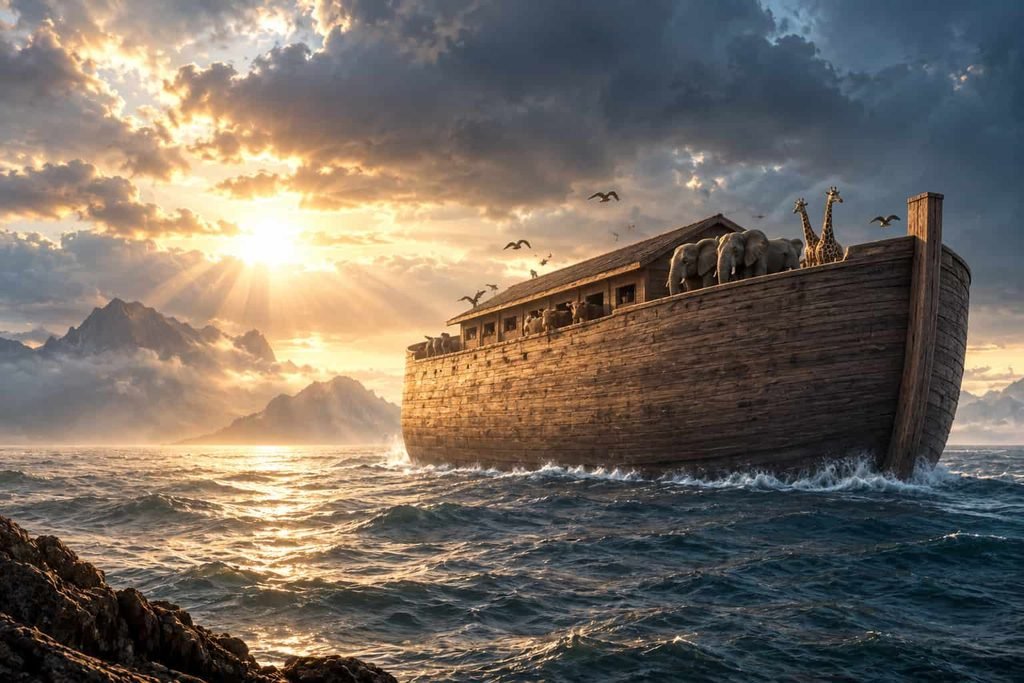
Prophet Noah: His Life and Story
The story of Prophet Noah (peace be upon him) is mentioned repeatedly in the Qur’an and is preserved in numerous traditional accounts.
According to the traditional account attributed to al-Tabarsi, Noah was the son of Methuselah, the son of Enoch (Idris), and he was the first prophet after Idris.
Some reports describe Noah as a carpenter.
He is also described as a prophet who devoted a remarkably long period of his life to calling his people to worship Allah.
How Long Did Prophet Noah Live?
The traditional reports differ regarding the exact length of Noah’s life.
Some reports state that he lived 1,450 years, while others give different figures.
Several narrations considered reliable in the source state that Noah lived for 2,500 years.
One detailed report divides his life into different periods:
- 850 years before his mission.
- 950 years calling his people to Allah.
- 200 years building the Ark.
- 500 years after descending from the Ark.
According to this account, Noah eventually settled people in different lands and established communities after the Flood.
The reports therefore preserve different figures concerning his lifespan, and the source itself notes that some of these differences may be explained by differences in what periods were included in the calculation.
Why Was He Called Noah?
Several traditional reports explain the name Noah (Nuh) in different ways.
One report states that his original name was al-Sakan, and that he was called Noah because he mourned over his people for 950 years.
Another narration states that his name was Abd al-Ghaffar, and that he was called Noah because he mourned for himself.
Another report gives his name as Abd al-Malik, explaining that he wept for 500 years.
A further narration gives the name Abd al-A’la.
The source explains that these reports share a common meaning: the names attributed to Noah emphasize his servitude and devotion to Allah.
Noah, the Grateful Servant
The Qur’an describes Noah as:
“Indeed, he was a grateful servant.”
Traditional commentary explains that Noah was deeply grateful to Allah.
Whenever he put on clothing, ate food, or drank water, he would praise and thank Allah.
He is also reported to have said “Bismillah” when beginning to eat or drink and “Alhamdulillah” afterward.
Another report states that every morning and evening Noah would acknowledge that every blessing he possessed, whether religious or worldly, came from Allah alone.
He would praise Allah and thank Him for His blessings until Allah was pleased.
Noah and the Long Years of Preaching
According to the traditional account attributed to Wahb, Noah remained among his people for 950 years, calling them to Allah.
Yet instead of becoming more obedient, they became increasingly rebellious.
The account describes the extreme rejection Noah faced.
Some members of his people would even bring their young children to him and warn them not to obey him.
They would describe Noah as a madman and instruct their children not to follow his message.
Despite this hostility, Noah continued his mission.
The People of Noah Attack Him
Noah’s people became so hostile that they would beat him severely.
According to the narration, they would strike him until he lost consciousness.
When he regained consciousness, he would say:
“O Allah, guide my people, for they do not know.”
The people would continue attacking him until blood flowed from his ears and he could no longer understand what was happening around him.
They would then carry him away and leave him unconscious at his home or at the entrance to his house.
Despite all of this, Noah continued to show patience.
Eventually, Allah revealed to him that no one from his people would believe except those who had already believed.
At that point, Noah prayed against his people and asked Allah not to leave upon the earth any of the disbelievers.
Noah and Iblis
One traditional narration describes an encounter between Noah and Iblis.
Iblis told Noah that he owed him a great favor and offered to give him advice.
Noah was troubled by this statement, so Allah revealed to him that he should speak with Iblis, and that Iblis would provide an argument against himself.
Noah asked him to speak.
Iblis explained that whenever he found a human being characterized by miserliness, greed, envy, tyranny, or haste, he could easily control that person.
If several of these characteristics came together, Iblis would consider such a person one of his devils.
Noah then asked about the great favor Iblis had mentioned.
Iblis replied that Noah had called upon Allah against his people, causing them all to perish. As a result, Iblis said that he had been freed from dealing with them for a long time.
Noah then asked Iblis when he had the greatest power over human beings.
Iblis replied:
“When they are angry.”
Noah and the Date Palm
Another traditional narration describes an extraordinary test involving a date palm.
Noah asked Allah to send punishment upon his people.
Allah instructed him to plant a date-palm seed and told him that when the tree grew and produced fruit, his people would perish.
Noah planted the seed and informed his companions.
When the tree grew and produced fruit, his companions asked him about the promise of punishment.
Allah then instructed Noah to plant it again.
Each time the tree matured and produced fruit, Noah’s companions were tested.
Some turned away from faith, some became hypocrites, while others remained firm with Noah.
According to the narration, this process was repeated ten times.
Each time, the believers were divided into groups: some abandoned Noah, some became hypocrites, and a smaller group remained steadfast.
Finally, during the tenth trial, one of Noah’s companions told him that even if he fulfilled the promise of punishment, they would still believe that he was a truthful prophet sent by Allah.
At that point, according to the narration, Allah destroyed the people who had rejected Noah and saved the faithful believers with him in the Ark.
Noah and His Ark
The traditional accounts describe Noah as a carpenter and state that he built the Ark according to Allah’s command.
One narration states that the Ark took many years to build.
The Ark was prepared to carry Noah, the believers, and pairs of living creatures.
The source also contains several narrations concerning the dimensions and construction of the Ark.
These reports vary in their details, and therefore they are best presented as traditional accounts rather than as one single undisputed description.
The Command to Enter the Ark
When Allah’s command came, Noah entered the Ark with those who believed with him.
The source states that only a small number of people believed in Noah.
One report attributed to Imam al-Sadiq states that eight people from Noah’s people believed with him.
The Ark also carried pairs of animals according to the command of Allah.
The Sign of the Flood
The traditional accounts contain different explanations of the expression concerning the Tannur, or “oven,” from which the water emerged.
One narration attributed to Imam Ali states that it was not an ordinary bread oven, but referred to the rising of the sun.
Other interpretations appear in the traditional sources.
The source therefore preserves the differing explanations rather than presenting one interpretation as the only possible one.
The Ark Begins Its Journey
When the appointed time came, the waters rose and the Ark began moving through the Flood.
According to one narration, Noah was instructed to repeat words of glorification to Allah if he feared drowning.
He was told to say a declaration of Allah’s oneness and then ask for salvation.
The wind became violent, and Noah feared that the Ark might sink.
He was unable to complete the instructed number of repetitions, so he uttered the words in the Syriac language.
According to the account, Allah then stabilized the Ark and allowed it to continue its journey.
Noah recognized the words through which Allah had saved him as something he should never forget.
He therefore engraved a declaration of Allah’s oneness upon his ring.
Noah’s Family and His Son
One of the most moving scenes in the story occurs when Noah sees one of his sons separated from the believers.
Noah called out to his son and urged him to enter the Ark.
His son refused and said that he would seek refuge on a mountain.
Noah warned him that nothing could protect him from Allah’s command.
Then a wave came between them, and the son was among those who drowned.
The source contains a narration explaining the expression “Noah called to his son” by stating that the son was the son of Noah’s wife according to a particular linguistic usage.
Mount al-Judi
According to the traditional reports, the Ark eventually came to rest upon Mount al-Judi.
One narration states that Allah had informed the mountains that the Ark would rest upon one of them during the Flood.
The mountains rose proudly, but al-Judi humbled itself.
The Ark therefore passed over the mountains until it reached al-Judi and came to rest there.
Noah called upon Allah for protection and asked Him to bring safety and order.
The Ark was then established upon the mountain.
How Long Did They Remain in the Ark?
The traditional reports differ concerning how long Noah and those with him remained aboard the Ark.
One narration attributed to Imam al-Sadiq states that they remained there for seven days and nights.
Another report gives a period of 150 days and nights.
Another traditional opinion states that the period was six months.
Because the source itself preserves these different reports, they should be presented as separate traditional accounts.
The Animals Aboard the Ark
The source contains a detailed account concerning the animals that Noah carried aboard the Ark.
It explains the command to carry pairs of animals, including domestic and wild varieties.
Among the animals mentioned are sheep, goats, cattle, and camels, together with wild animals and birds.
The source also explains that the purpose was to preserve the means of life for Noah’s descendants after the Flood.
The Few Who Believed With Noah
The Qur’anic statement that only a few believed with Noah is explained in one traditional report as referring to eight people.
The emphasis of the account is not on the number itself, but on the small number of people who remained faithful despite the long period of Noah’s preaching.
Noah and the Ark’s Nails
One traditional narration describes the Ark as having special nails associated with the names of members of the Prophet’s family.
According to this narration, the first nail represented Prophet Muhammad, followed by Ali, Fatimah, Hasan, and Husayn.
The narration describes the nails as shining and radiant.
When the nail associated with Husayn was struck, it produced a special moisture, which Gabriel interpreted as a sign of the blood that would later be shed in the tragedy of Husayn.
This account belongs to the traditional narrations preserved in the source.
The Story of the Scorpion
Another traditional account concerns Noah and the scorpion.
When Noah was preparing to enter the Ark, he initially refused to carry the scorpion.
The scorpion promised that it would not sting anyone who said:
“Peace be upon Muhammad and the family of Muhammad, and upon Noah among the worlds.”
Noah therefore allowed it to enter the Ark.
Noah’s Grief After the Flood
When the waters receded and the remains of those who had perished became visible, Noah was overcome with intense grief.
The sight deeply saddened him.
According to one narration, Allah revealed to him that he should eat black grapes in order to relieve his sorrow.
This account portrays Noah not only as a prophet who endured immense hardship but also as a compassionate servant deeply affected by the fate of humanity.
Noah’s Prayer and His Long Mission
Noah’s story is one of extraordinary patience.
He called his people to Allah for centuries.
They rejected him, mocked him, attacked him, and attempted to turn their children against him.
Yet he continued his mission until Allah informed him that no further believers would come from his people.
Only then did he pray for their destruction.
The Flood therefore came after a long period of warning, preaching, patience, and rejection.
Noah’s Death
One traditional narration describes the final moments of Noah’s life.
After living for many centuries, the Angel of Death came to him.
Noah was sitting in the sunlight.
The Angel of Death greeted him and told him that he had come to take his soul.
Noah asked whether he could first move from the sunlight into the shade.
The Angel agreed.
After moving into the shade, Noah reflected upon the entire span of his earthly life.
He said that his experience of the world was like moving from the sunlight into the shade.
He then told the Angel of Death to carry out the command of Allah.
The Angel of Death took his soul.
The Legacy of Prophet Noah
According to another traditional report, after Noah’s death, Gabriel came to him during the period following the Flood and instructed him to pass the knowledge and divine inheritance he possessed to his son Shem (Sam).
The report describes Shem as the inheritor of Noah’s knowledge.
It also states that Noah’s other sons, Ham and Japheth, did not possess the same knowledge.
The account presents Noah’s legacy as the preservation of divine knowledge from one generation to another.
The Resting Place of Noah
The source states that many reports indicate that the grave of Prophet Noah is in Najaf, alongside the grave of Imam Ali.
This is presented in the source as the position supported by the majority of the reports cited there.
The Most Important Lessons From Noah’s Story
The story of Prophet Noah contains profound lessons for believers:
- Patience can endure even centuries of rejection.
- A prophet’s duty is to convey the message, even when people refuse to listen.
- Gratitude should accompany every blessing.
- Arrogance, greed, envy, and anger can lead people toward destruction.
- Repentance and faith remain possible until the divine decree arrives.
- A small number of sincere believers can remain firm despite overwhelming opposition.
- Allah’s justice comes after warning and the establishment of proof.
- The life of this world is temporary, no matter how long it may appear.
- Divine knowledge should be preserved and passed on to future generations.
Conclusion
Prophet Noah (peace be upon him) stands in the traditional Islamic accounts as an example of extraordinary patience, gratitude, steadfastness, and devotion to Allah.
He spent a vast portion of his life calling his people to worship Allah, despite their rejection and hostility.
The story of the Ark and the Flood represents the culmination of a long period of warning and perseverance.
Although the traditional sources contain differences in some details—such as Noah’s exact lifespan, the duration of the Flood, and certain events surrounding the Ark—these accounts consistently portray Noah as a devoted servant of Allah who remained faithful to his mission.
His story continues to remind believers that truth does not depend upon the number of those who accept it, and that patience and faith remain among the greatest qualities of the servants of Allah.