
Prophet Hud and the People of Ad
Allah says:
“And to the people of Ad We sent their brother Hud. He said, ‘O my people, worship Allah; you have no deity other than Him. Will you not fear Him?’”
(Qur’an 7:65)
The story of Prophet Hud (peace be upon him) and the people of Ad is mentioned in several chapters and verses of the Qur’an.
The traditional accounts describe Ad as a powerful people who lived after the people of Prophet Noah (peace be upon him).
They were blessed with great physical strength, abundant crops, palm trees, and long lives. Yet they became proud of their strength and turned to the worship of idols.
Allah sent Hud to call them back to the worship of the One God.
Who Were the People of Ad?
According to the traditional genealogical accounts in the source, Ad was descended from the lineage of Shem, son of Noah.
Hud himself is also given several genealogical lineages in the traditional reports.
The people of Ad were described as among the inhabitants of the earth who came after the people of Noah.
They were said to have been exceptionally strong and physically large.
One report states that their tallest men reached one hundred cubits, while their shortest were seventy cubits.
Imam al-Baqir is reported to have described them as being like tall palm trees.
Their strength was so great, according to the narration, that a man among them could strike a mountain with his hand and break off a piece of it.
The Idols of Ad
Despite their strength and prosperity, the people of Ad worshipped idols that they regarded as gods.
According to the traditional explanation, they assigned different powers to different idols.
One idol was believed to provide rain and fertility.
Another was associated with providing sustenance.
Another was believed to cure the sick.
Another was regarded as a companion or protector during travel.
Hud challenged these beliefs and asked his people how they could argue about names they had invented and assigned to their idols.
He called them to abandon idol worship and worship Allah alone.
But they refused to accept his message.
The Pride and Arrogance of Ad
The people of Ad were not only physically powerful; they were also proud of their wealth and strength.
They constructed buildings in elevated places.
According to one traditional interpretation, they built structures overlooking roads so that they could watch travelers, mock them, and amuse themselves at their expense.
Another interpretation explains the Qur’anic reference to building upon every high place as referring to structures built merely for amusement and vanity.
Their strength and wealth made them believe that nothing could overcome them.
Hud Calls His People to Allah
Hud continued calling his people to Allah.
He reminded them that their prosperity came from Allah and that they should abandon their idols.
He called them to repentance and seeking forgiveness.
Allah quotes Hud as saying:
“O my people, ask forgiveness of your Lord and then repent to Him; He will send the sky upon you in abundant rain and increase you in strength upon your strength. And do not turn away as criminals.”
(Qur’an 11:52)
Hud’s message was clear:
Return to Allah, seek His forgiveness, abandon false gods, and He will restore His blessings.
But the people of Ad rejected him.
They said:
“O Hud, you have not brought us clear evidence, and we are not going to abandon our gods because of your word, nor are we believers in you.”
The Drought Begins
According to a traditional account attributed to the commentary of Ali ibn Ibrahim, the people of Ad lived in a land filled with crops and palm trees.
They had long lives and powerful bodies.
When they rejected Hud and continued worshipping idols, Allah withheld the rain from them.
The drought continued for seven years.
Their land became barren, and their prosperity disappeared.
Hud himself is described in this account as a farmer who cultivated the land and watered his crops.
During the drought, a group of people came to his house seeking him.
His wife came out to them.
They explained that their land had become barren and that they had come to ask Hud to pray to Allah for rain.
She responded that if Hud’s prayer were answered, he would surely pray for himself as well.
She explained that even his own crops had been damaged because of the lack of water.
The people asked where Hud was.
She directed them to him.
They went to Hud and asked him to pray to Allah for rain.
Hud prayed for them.
He then told them to return home because rain had been sent to them.
The people were amazed.
They told Hud about the strange conversation they had had with his wife and described her appearance and words.
Hud explained that she was his wife.
He said that he prayed to Allah that she might have a long life.
The people wondered why.
Hud replied that every believer has an enemy who harms him.
His wife was his enemy, he explained, but it was better for his enemy to be someone under his authority than someone who had authority over him.
This account portrays Hud as patient even with those closest to him and as someone who preferred to endure an enemy he could control rather than become subject to an enemy who controlled him.
Hud Continues His Mission
Hud remained among his people, calling them to Allah and warning them against worshipping idols.
He reminded them that repentance and seeking forgiveness could restore Allah’s blessings.
He told them that if they sincerely sought forgiveness and turned back to Allah, He would send abundant rain and increase their strength.
But they refused.
Their pride prevented them from accepting the truth.
They demanded clear proof and insisted that they would never abandon their idols.
The People of Ad Challenge Hud
The people of Ad accused Hud of being affected by their gods.
They told him that they believed some of their idols had harmed him because he had insulted them.
They essentially claimed that Hud had lost his reason because he opposed their gods.
Hud did not abandon his mission.
He continued warning them that their strength and idols could not protect them from the punishment of Allah.
The Black Cloud
When the people of Ad continued rejecting Hud, Allah withheld the rain from them.
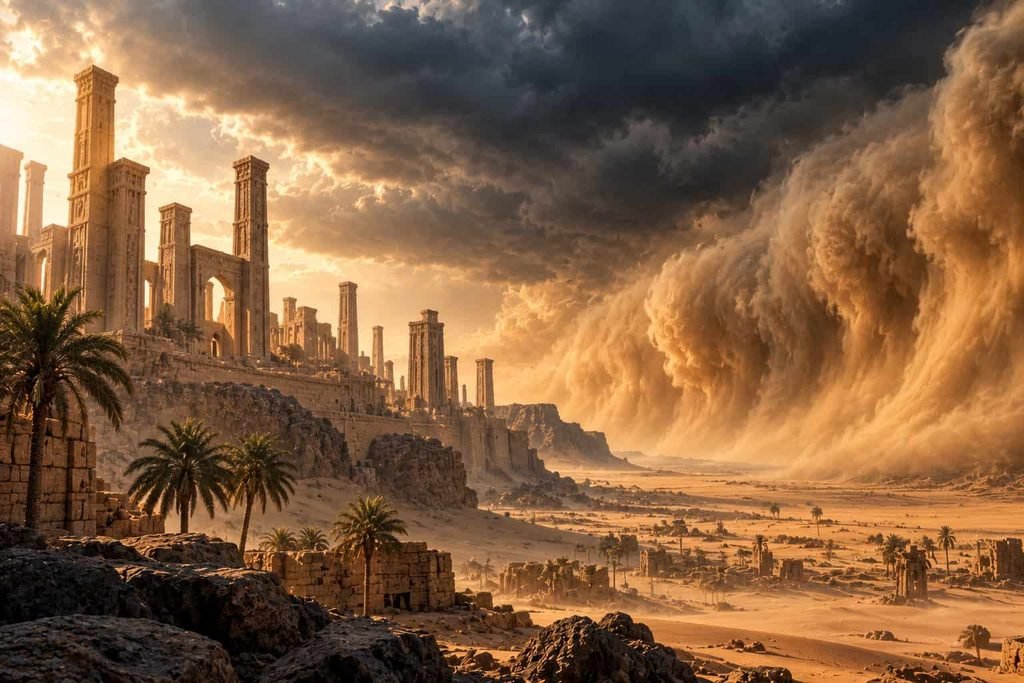
Eventually, a dark cloud appeared in the sky.
The people of Ad were delighted when they saw it.
They believed that it was a rain cloud coming to end their drought.
They said:
“This is a cloud bringing us rain.”
But Hud knew what was coming.
He told them that it was not a rain cloud.
It was the punishment they had been asking to hasten.
Allah then sent upon them a devastating wind.
The Great Wind
The Qur’an describes the punishment of Ad as a powerful and destructive wind.
Allah says:
“As for Ad, they were destroyed by a furious, bitter wind. He subjected it to them for seven nights and eight days, continuously.”
(Qur’an 69:6–7)
The traditional accounts describe the wind as extremely cold and violent.
It destroyed everything in its path.
Hud and those who believed with him withdrew to a protected place.
The wind that reached the believers was gentle, while the wind that struck Ad was devastating.
According to the narration, the wind passed over the people of Ad, lifting their men and women into the air and throwing them down.
Their homes and structures were destroyed.
The people were left like the hollow trunks of fallen palm trees.
Seven Nights and Eight Days
The Qur’an states that the wind was sent against them for:
Seven nights and eight days.
One traditional explanation connects these days with what the Arabs called the “Days of the Old Woman”, a period associated with cold weather and strong winds.
According to the report, the name was connected to an old woman who entered a shelter, only for the wind to follow her and kill her on the eighth day.
The Barren Wind
Another traditional report describes the destructive wind as the barren wind.
It was described as a wind that brought punishment but no mercy.
According to the narration, when Allah’s anger came upon the people of Ad, the keepers of the wind were commanded to release only a tiny amount of it.
Yet even that small opening produced a violent force.
The keepers of the wind became frightened and appealed to Allah because they feared that the wind might destroy people who had not disobeyed Him.
Allah then sent Gabriel.
Gabriel restrained the wind with his wing and commanded it to leave only according to the command it had been given.
The wind obeyed.
It then destroyed the people of Ad and those who were with them.
The Wind That Destroyed Ad
The traditional reports emphasize the extraordinary power of the wind that Allah sent against Ad.
It is described as a force capable of destroying buildings, fortresses, mountains, and cities.
The wind lifted people from the ground and carried them upward before throwing them down.
It also destroyed their homes and reduced structures to sand.
The narration explains that much of the sand in their land was the result of the wind grinding down their buildings and cities.
The people were left like:
“Hollow trunks of palm trees.”
This image reflects the complete destruction that befell a civilization that had once considered itself powerful and invincible.
Why Was Ad Called Iram of the Pillars?
The traditional source gives an explanation for the expression Iram of the Pillars.
It states that the people of Ad were known for extracting enormous pillars from mountains.
They would cut the pillars from the mountains and make them as long as the mountains from which they had been taken.
They would then transport and erect these pillars and build magnificent palaces upon them.
Because of these enormous structures and pillars, the people became known in the traditional account as Iram of the Pillars.
Their buildings represented their immense physical power and their pride in worldly achievement.
Yet all of their strength and architecture could not save them from the punishment of Allah.
The Land of Al-Ahqaf
The traditional reports identify the land of Ad with Al-Ahqaf, a region associated with extensive sand dunes.
One explanation describes Al-Ahqaf as vast areas of sand stretching between Oman and Hadramawt.
Another report places it in Yemen overlooking the sea.
The people of Ad therefore lived in a region that was known for its deserts, fertile areas, palm trees, and great prosperity.
The Discovery of the Remains of Ad
The source contains another remarkable traditional account involving a deep well.
A ruler ordered a well to be dug in search of water.
The workers continued digging to extraordinary depths without finding water.
Eventually, they reached a rock.
When they struck the rock with a tool, it broke open and a powerful cold wind emerged.
Those who were near the opening died.
The ruler was informed of what had happened.
When they did not understand the nature of what they had discovered, they sought an explanation from Imam al-Hasan al-Askari.
According to the report, he explained that the place was the land of Al-Ahqaf, the land of the people of Ad whom Allah had destroyed with the furious wind.
The account states that the land had once been rich and prosperous.
Then Allah withheld rain for seven years.
The people rejected Hud, and Allah informed him that punishment would come upon them at an appointed time.
When the appointed time arrived, they saw clouds approaching and rejoiced, believing that rain was coming.
Hud told them that what they were seeing was the punishment they had demanded to hasten.
The people of Ad were then destroyed.
The Mysterious City of Iram
The traditional source also contains a lengthy account about a magnificent city identified as Iram of the Pillars.
A man named Abdullah ibn Qilabah is said to have entered the desert in search of his lost camels.
While traveling through the wilderness, he unexpectedly came upon a city surrounded by a fortress.
He saw enormous buildings and towering structures.
When he approached, he found enormous gates unlike anything he had seen before.
The gates were described as being made from beautiful wood and decorated with precious stones.
He entered the city.
Inside, he saw magnificent palaces supported by pillars of precious stones.
The buildings were described as being made from gold, silver, pearls, rubies, and emeralds.
There were also trees bearing fruit and rivers flowing beneath them.
The man was astonished by what he saw.
He believed that he had entered the paradise Allah had promised His servants in this world.
He praised Allah and collected some pearls, musk, and saffron before leaving the city.
He could not remove the precious stones that were fixed into the walls and doors.
The Story Reaches Muawiya
According to the traditional account, the man eventually returned to Yemen and showed people what he had brought from the mysterious city.
Some of the pearls had changed color over the long period during which he had carried them.
News of the story spread and eventually reached Muawiya ibn Abi Sufyan.
Muawiya summoned the man and asked him about what he had seen.
The man described the city and showed him the objects he had brought back.
Muawiya reportedly remarked that even Solomon, son of David, had not been given a city like this.
He then asked Ka’b al-Ahbar whether he knew of such a city.
Iram of the Pillars in the Traditional Account
Ka’b al-Ahbar identified the city as Iram of the Pillars.
He explained that it had been built by Shaddad ibn Ad, whom the account identifies with the earlier people of Ad.
According to this narration, Shaddad had been fascinated by descriptions of Paradise.
He wanted to build a city on earth resembling the Paradise described in the scriptures.
He therefore ordered his workers to build a magnificent city filled with gold, silver, pearls, rubies, emeralds, gardens, and flowing rivers.
The construction was said to have taken three hundred years.
Shaddad himself was said to have lived for nine hundred years.
The End of Shaddad
When the city was completed, Shaddad ordered a great fortress to be constructed around it.
He also ordered thousands of palaces and banners to be established around the city.
After everything was completed, Shaddad prepared to enter Iram with his army and followers.
According to the narration, when they were only about a day’s journey away, Allah sent a mighty cry from the heavens.
The cry destroyed Shaddad and everyone who was with him.
They never entered Iram.
The traditional account presents this as a powerful reminder that even the greatest worldly achievements cannot protect a person from divine punishment when arrogance and rebellion prevail.
A Warning for Later Generations
The source concludes these accounts with a spiritual warning.
The destruction of ancient nations is presented as a lesson and a warning for later generations.
The story of Ad is therefore not merely a story about a civilization that disappeared.
It is a warning against arrogance, idol worship, injustice, and reliance upon worldly strength.
The people of Ad believed that their physical power and magnificent buildings made them invincible.
But their strength could not protect them.
Their wealth could not protect them.
Their idols could not protect them.
And their magnificent city could not protect them.
Lessons From the Story of Prophet Hud
The story of Prophet Hud and the people of Ad contains many important lessons:
- Strength and wealth are blessings only when used with gratitude and obedience to Allah.
- Pride can turn blessings into a source of destruction.
- Idols and false gods cannot provide protection or benefit.
- Seeking Allah’s forgiveness is a means of returning to His mercy.
- A prophet continues his mission even when his people reject him.
- Material achievements cannot save a person from divine judgment.
- The destruction of earlier nations should serve as a warning to later generations.
- True strength belongs to Allah.
- Repentance should not be delayed until punishment becomes unavoidable.
Conclusion
The story of Prophet Hud (peace be upon him) and the people of Ad is one of the great stories of warning found in the traditional Islamic sources.
The people of Ad were described as powerful, prosperous, and physically strong. They possessed fertile lands, palm trees, impressive buildings, and great wealth.
Yet instead of thanking Allah, they became arrogant and worshipped idols.
Hud called them to worship Allah alone and urged them to seek forgiveness and repent.
They rejected his message.
Eventually, Allah sent upon them the furious wind that had been promised.
For seven nights and eight days, the wind devastated their land, destroyed their homes, and brought an end to their civilization.
The story reminds us that no amount of power, wealth, architecture, or worldly achievement can protect a people who turn away from truth and persist in arrogance.
For believers, the story of Hud is ultimately a call to humility, repentance, gratitude, and complete reliance upon Allah.