
Introduction
Moreover, Prophet Ibrahim (Abraham), peace be upon him, holds a unique and honored position in the history of divine revelation.
He is described as the father of prophets and the Khalil of Allah, the intimate friend of God.
Indeed, the story and life of Prophet Ibrahim are mentioned throughout the Qur’an because of his extraordinary faith.
Additionally, his devotion, generosity, patience, and complete submission to Allah are highlighted.
The Qur’an emphasizes his unique faith:
“Abraham was neither a Jew nor a Christian, but he was a true monotheist, a Muslim, and he was not among the polytheists.”
The people who truly have the strongest connection to Ibrahim are those who follow his path of faith and devotion.
But what made Ibrahim worthy of such an honored position?
The traditions attributed to the Imams of Ahl al-Bayt describe several qualities that distinguished him: his generosity, his worship, his remembrance of Allah, his hospitality toward guests, and his refusal to turn anyone away.
Why Was Prophet Ibrahim Called the “Khalil of Allah”?
One of the most famous titles of Prophet Ibrahim is Khalil al-Rahman, meaning the intimate friend of the Most Merciful.
According to a narration attributed to Imam al-Rida, Allah chose Ibrahim as His intimate friend because he never turned anyone away and never asked anyone except Allah.
Other narrations explain his special status through different qualities.
Imam al-Sadiq is reported to have explained that Ibrahim was chosen as Allah’s intimate friend because of his frequent prostration upon the earth.
Another narration attributed to Imam Muhammad al-Askari connects Ibrahim’s special rank with his abundant prayers upon Muhammad and the family of Muhammad.
A further narration describes his generosity and night worship, stating that Ibrahim was known for feeding people and praying during the night while others were asleep.
These traditions present the title Khalil Allah not merely as an honor, but as a reflection of Ibrahim’s remarkable devotion and character.
Ibrahim and the Angel of Death
One narration describes a remarkable encounter that took place when Allah granted Ibrahim the rank of Khalil.
The Angel of Death came to Ibrahim in the appearance of a young man with a fair complexion. Ibrahim, who was known for being protective of his household, questioned the stranger and asked how he had entered his home.
The visitor replied that the Lord of the house had allowed him to enter.
Ibrahim responded that the Lord of the house had greater authority over it than he did.
When the visitor revealed that he was the Angel of Death, Ibrahim became concerned that he had come to take his soul. But the angel explained that he had not come for that purpose.
Instead, he had come with good news:
Allah had chosen Ibrahim as His intimate friend.
When Ibrahim asked who this person was so that he might serve him until his death, the Angel of Death told him:
“You are he.”
Ibrahim then went to Sarah and told her that Allah had chosen him as His intimate friend.
Ibrahim’s Hospitality and Generosity
Hospitality was one of the qualities strongly associated with Prophet Ibrahim.
A narration attributed to Imam Ali states that Ibrahim was among the first to honor guests with hospitality. It also describes him as among the first people to develop gray hair, which was described as a sign of dignity in this world and light in the Hereafter.
Another narration illustrates his generosity through a remarkable story involving food.
When messengers came to Ibrahim, he brought them a calf and invited them to eat. They did not eat until he explained the proper manner of beginning and ending the meal. Ibrahim told them to say “Bismillah” when they began eating and “Alhamdulillah” when they finished.
The narration presents this as one of the qualities that demonstrated why Ibrahim deserved the rank of Allah’s intimate friend.
The Miracle of the Flour
Another story illustrates Ibrahim’s trust in Allah and his concern for his family.
Ibrahim once traveled to visit a friend in Egypt because he hoped to obtain some food. When he arrived, however, he did not find his friend at home.
Ibrahim did not want to return with his camel carrying nothing, so he filled his sack with sand and returned home.
When he arrived, he left the camel and entered the house. Sarah later opened the sack and, according to the narration, found it filled with excellent flour.
She used the flour to prepare food for Ibrahim.
When he asked where the flour had come from, she explained that it was from what he had brought back from his Egyptian friend.
Ibrahim then clarified that his friend was not actually an Egyptian friend — rather, he was a friend of Allah.
The narration concludes that Ibrahim thanked and praised Allah and ate the food.
This story highlights a central theme in the traditions about Ibrahim: trust in Allah accompanied by generosity toward others.
Ibrahim and the Trial of the Fire
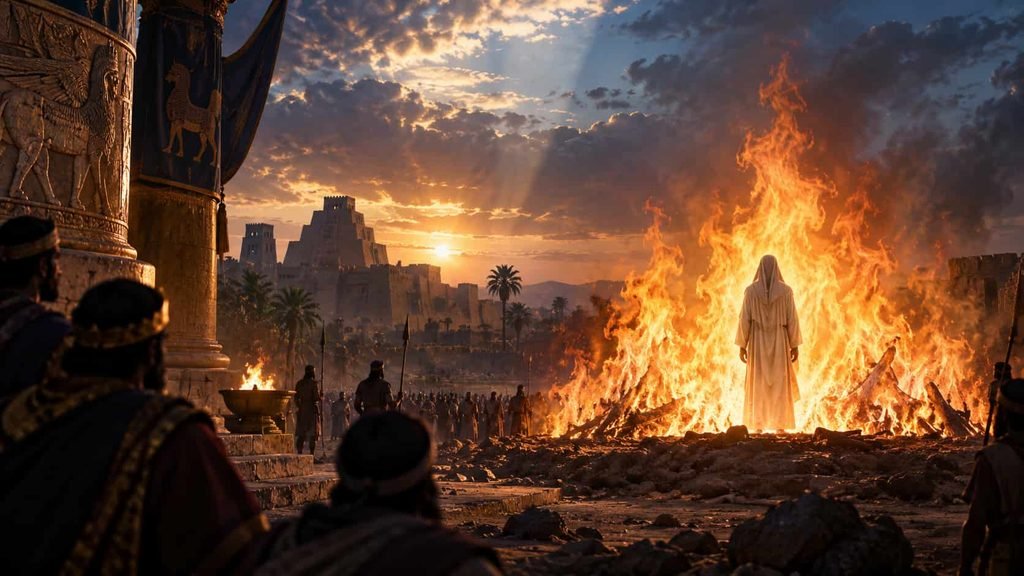
Prophet Ibrahim faced one of the greatest trials described in his story when he was thrown into the fire.
According to a narration attributed to Imam al-Sadiq, when Ibrahim was thrown into the fire, Gabriel met him while he was falling and asked:
“O Ibrahim, do you have a need?”
Ibrahim replied that he had no need from Gabriel.
His response reflects his complete reliance upon Allah even in the most difficult moment.
Ibrahim’s faith did not depend upon the circumstances surrounding him. Whether he was receiving guests, facing hardship, or being thrown into the fire, his heart remained directed toward Allah.
Ibrahim as a Nation of Faith
The traditions also describe Ibrahim as someone who stood alone in his devotion to Allah.
Imam al-Sadiq is reported to have said that there was a time when there was only one person on earth worshiping Allah. That person was Ibrahim.
The Quranic description of Ibrahim as “an entire nation, devoutly obedient to Allah and a true monotheist” is used to illustrate the extraordinary strength of his faith.
He remained patient for as long as Allah willed, and later Allah comforted him through Ishmael and Isaac, making them three believers together.
This teaches an important lesson: faith is not measured by numbers. A single believer who remains sincere can represent an entire path of truth.
From Servant to Prophet, Messenger, Friend, and Imam
One of the most significant narrations in the source describes the stages through which Allah elevated Ibrahim.
According to Imam al-Sadiq, Allah first chose Ibrahim as a servant before choosing him as a prophet.
He was then chosen as a prophet before being chosen as a messenger.
He became a messenger before being chosen as an intimate friend.
And he was chosen as an intimate friend before Allah appointed him as an Imam.
After Allah had brought these qualities together in him, He declared:
“Indeed, I am going to make you an Imam for the people.”
Ibrahim then asked about his descendants, and Allah answered that His covenant would not reach the wrongdoers.
This narration presents Ibrahim’s spiritual journey as a progression of responsibility and divine honor.
Ibrahim and the Story of Maria
Among the less commonly known stories connected to Ibrahim is the account of a man named Maria ibn Awi.
According to the narration, Maria had lived for an extraordinarily long period and worshiped Allah in a secluded place separated from the people by deep water.
He would come out among the people only once every three years and spend time worshiping Allah in a prayer sanctuary.
One day, he encountered a flock of sheep and saw a young man whose face was described as resembling the light of the rising moon.
Maria asked the young man who owned the sheep.
The young man answered:
“They belong to Ibrahim, the intimate friend of the Most Merciful.”
When Maria asked who he was, the young man replied that he was Ibrahim’s son, Isaac.
Maria then prayed that Allah would allow him to see His servant and intimate friend before he died.
Ibrahim Walks Across the Water
When Ibrahim later met Maria, he learned that Maria lived across a body of deep water.
Ibrahim asked how he could reach the place.
Maria answered that he simply walked across the water.
Ibrahim replied that perhaps the One who had subjected the water to Maria could also subject it to him.
They then set out together.
Maria placed his foot upon the water and said:
“Bismillah.”
Ibrahim did the same.
To Maria’s amazement, Ibrahim walked across the water just as he did.
Ibrahim stayed with him for three days without revealing his identity.
Eventually, Maria asked Ibrahim to pray that they might remain together in that place.
Ibrahim explained that he could not make such a prayer because he had already prayed for something three years earlier and had not yet received an answer.
Maria asked about that prayer.
Ibrahim then told him the story of his encounter with Isaac and his desire to meet Allah’s intimate friend.
At that moment, Ibrahim revealed his identity:
“Allah has answered your prayer. I am Ibrahim.”
Maria stood and embraced him.
The narration describes this as the first embrace.
Ibrahim and Prophet Lot
The traditions also attribute an important act of rescue to Ibrahim.
According to a narration from Imam al-Kadhim through al-Rawandi, the Messenger of Allah said that Ibrahim was the first to fight in the way of Allah.
The narration connects this event with Lot, who had been captured by the Romans. Ibrahim went out and rescued him from their hands.
This account adds another dimension to Ibrahim’s character: his willingness to act to protect and rescue others.
Ibrahim and Circumcision
The same narration mentions Ibrahim in connection with circumcision and states that he underwent circumcision at an advanced age.
However, the source itself immediately discusses other narrations concerning the prophets and circumcision, noting that many reports state that prophets were born circumcised.
Therefore, this particular point should be understood within the context of the different narrations discussed in the source rather than presented as an uncontested historical detail.
Ibrahim’s Faith During Times of Hardship
Another narration tells of a time when Ibrahim went to obtain food for his household during severe famine.
He encountered such hardship that he returned without food.
Near his home, he filled his sack with sand because he wanted to ease Sarah’s worry.
When he arrived home, Sarah opened the sack and found it filled with flour.
She prepared bread from it and asked Ibrahim to stop praying and eat.
When Ibrahim learned where the flour had come from, he looked toward the heavens and said:
“I bear witness that you are indeed the Khalil.”
The story again connects Ibrahim’s intimate relationship with Allah to his generosity, trust, and concern for his family.
Ibrahim and the Sign of Gray Hair
The traditions also connect Ibrahim with the appearance of gray hair.
According to a narration attributed to Imam Ali, people could reach old age without their hair turning gray, making it difficult to distinguish fathers from their grown sons.
Ibrahim prayed to Allah for a sign by which he could be recognized.
His hair and beard then became gray and white.
The narration describes this as a distinguishing sign associated with him.
Ibrahim’s Compassion Toward Children
The traditions contain a beautiful description of the care given to children of believers who die at a young age.
According to one narration, these children are beneath the Throne of the Most Merciful, seeking forgiveness for their parents.
Ibrahim embraces them, while Sarah cares for them in a place described as being filled with musk, amber, and saffron.
The source also mentions other narrations concerning the care of children in Paradise, including reports that Lady Fatimah cares for some of them.
These narrations portray Paradise as a place of mercy, care, and reunion.
The Legacy of Prophet Ibrahim
The life of Prophet Ibrahim represents a profound example of faith, devotion, hospitality, patience, and complete dependence upon Allah.
He was described as:
- A true monotheist.
- The father of the prophets.
- One of the great messengers of determination.
- The intimate friend of Allah.
- A generous host who honored his guests.
- A devoted worshiper who prayed during the night.
- A man who relied upon Allah during severe trials.
- An example of patience and trust.
- A leader whose spiritual rank culminated in being appointed an Imam.
His greatness was not based merely on his position, but on the qualities that characterized his life.
He gave food to others, welcomed guests, worshiped Allah, remained patient through hardship, and refused to depend upon anyone except his Lord.
Lessons from the Life of Prophet Ibrahim
The story of Ibrahim offers several enduring lessons:
1. True Faith Can Stand Alone
Ibrahim remained devoted to Allah even when he stood alone among his people.
2. Generosity Is a Sign of Faith
His hospitality and willingness to feed others are repeatedly mentioned among his virtues.
3. Depend on Allah
When Ibrahim was thrown into the fire, he did not seek his ultimate reliance from anyone other than Allah.
4. Worship Requires Sincerity
His frequent prostration, night prayers, and devotion are presented as reasons for his elevated spiritual rank.
5. Patience Has a Reward
Ibrahim experienced trials and waited for prayers to be answered, yet he continued to trust Allah.
6. Spiritual Rank Comes With Responsibility
The narration describing Ibrahim’s progression from servant to prophet, messenger, intimate friend, and Imam demonstrates the increasing responsibility associated with divine selection.
Conclusion
Prophet Ibrahim, peace be upon him, remains one of the greatest examples of sincere faith and complete submission to Allah.
His title Khalil Allah, the intimate friend of Allah, is associated in the traditions with qualities such as generosity, worship, hospitality, patience, remembrance, and complete reliance upon his Lord.
His story reminds believers that true closeness to Allah is reflected in both worship and character.
Ibrahim did not merely believe in Allah; he demonstrated his faith through his actions, his generosity, his patience, and his unwavering trust.
For this reason, his legacy continues to hold a central place in the history of the prophets and in the spiritual tradition of believers.