
Introduction to Prophet Ibrahim Abraham
The story of Prophet Ibrahim (Abraham), peace be upon him, is one of the most remarkable stories in the history of the prophets.
Prophet Ibrahim Abraham faced trials that tested his faith, courage, and patience.
They demanded complete reliance upon Allah.
He challenged idolatry, confronted a powerful ruler, and broke the idols worshiped by his people.
Yet the fire that was intended to destroy Ibrahim became one of the greatest signs of Allah’s power.
Prophet Ibrahim Abraham is described with the circumstances of his birth. The narrative then follows his early search for the truth. It also covers his relationship with his father. These elements set the stage for his later challenges and revelations. The tone remains formal and focused on his quest.
He confronts idol worshipers with reason and clarity. The account also describes his debate with Nimrod. These episodes illustrate his steadfast conviction and willingness to challenge powerful figures. The narrative connects his questions to broader concerns about faith and obedience.
Eventually he leaves his homeland to pursue truth elsewhere. This departure marks a turning point in his story. The chapter frames his journey as a response to divine guidance and the calls of conscience. It also hints at the beginnings of a mission that will unfold in later chapters.
The Birth of Prophet Ibrahim
According to the narration attributed to Imam al-Sadiq, Ibrahim was born during a time when Nimrod ibn Canaan ruled with great power and tyranny.
Nimrod had become arrogant because of the worldly kingdom he possessed and eventually claimed lordship for himself.
Astrological calculations had led those around him to believe that a man would soon appear who would challenge the established religion and call people toward another faith.
Nimrod therefore became determined to prevent the birth of such a person.
He ordered a separation between men and women in an attempt to prevent the predicted child from being born.
But Allah’s decree could not be prevented.
Ibrahim’s mother became pregnant with him, yet her pregnancy did not become apparent.
When the time of his birth approached, she withdrew from her husband under the pretext of illness and went into a cave.
There, she gave birth to Ibrahim.
She wrapped the newborn child, left him in the cave, and returned home after closing its entrance with stones.
According to the narration, Allah provided Ibrahim with nourishment, and his mother would secretly visit him.
At the same time, Nimrod had ordered that male children born during that period be killed.
Ibrahim’s mother therefore kept him hidden from the ruler’s men.
Ibrahim’s Extraordinary Growth
The narration describes Ibrahim’s growth in the cave as extraordinary.
While an ordinary child would grow gradually over many months, Ibrahim’s physical development was much faster.
He remained in the cave until he had reached approximately thirteen years of age.
When his mother eventually visited him again, Ibrahim asked her to take him outside.
She warned him that Nimrod would kill him if he discovered that he had been born during that period.
Eventually, Ibrahim left the cave.
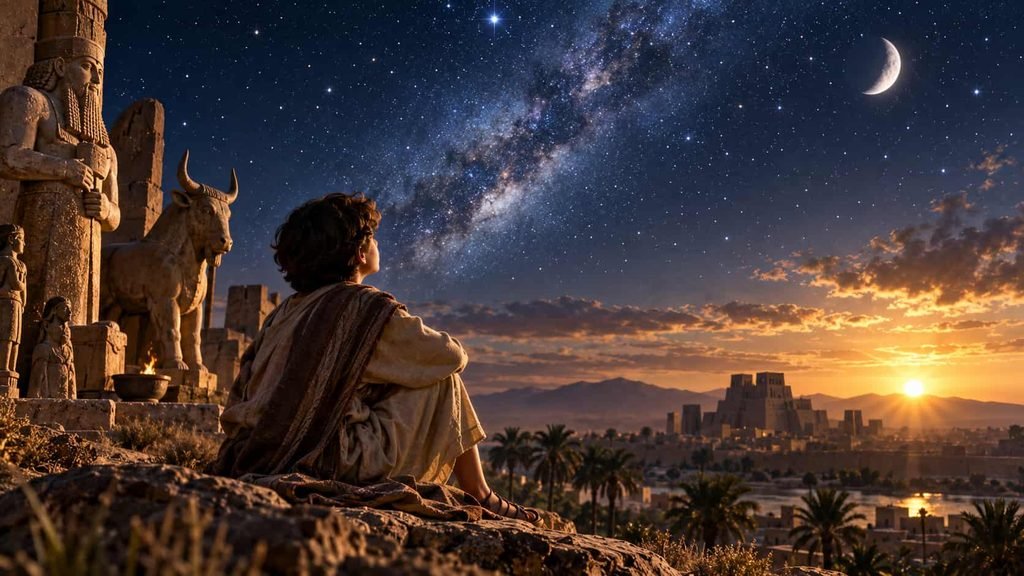
That night, he looked toward the sky and began contemplating the celestial bodies.
His journey toward recognizing the Creator began through reflection upon the changing nature of the things around him.
Ibrahim’s Search for the Truth
When Ibrahim observed the star, he said:
“This is my Lord.”
But when the star disappeared, he rejected the idea that it could be divine.
He then observed the moon and said:
“This is my Lord.”
But when the moon disappeared as well, he recognized that something which changes and vanishes cannot be the eternal Creator.
When morning came and Ibrahim saw the sun in all its brilliance, he said:
“This is greater.”
But when the sun also disappeared, the truth became clear.
Ibrahim then declared:
“O my people, indeed I am free of what you associate with Allah. Indeed, I have turned my face toward the One who created the heavens and the earth, inclining toward truth, and I am not among those who associate partners with Allah.”
This passage represents Ibrahim’s rejection of the worship of created things and his turning completely toward the Creator.
The source explains that scholars have offered several interpretations of his words concerning the star, moon, and sun.
One interpretation is that Ibrahim was reasoning with his people and presenting their own beliefs back to them in order to demonstrate their contradiction.
Another interpretation understands his statements as part of a process of argumentation rather than actual belief in the divinity of the celestial bodies.
The purpose of the argument was to demonstrate that anything subject to disappearance and change cannot be the eternal Lord.
Ibrahim Returns to His Family
After reaching certainty in his faith, Ibrahim returned to his mother.
She brought him into the house and placed him among her other children.
His father, Azar, saw him and was surprised.
He asked who this child was who had survived while the ruler was killing the sons of other people.
Ibrahim’s mother explained that he was her son and that she had given birth to him during the period when she had withdrawn from her husband.
Azar was closely connected with Nimrod and was involved in making idols for him and for the people.
The idols were given to his children to sell.
But Ibrahim was different.
He refused to accept the idols as objects worthy of worship or respect.
Ibrahim and the Idols
According to the narration, Azar gave Ibrahim idols to sell just as he gave them to his other sons.
But Ibrahim would attach ropes around the idols and drag them along the ground.
He would mock their inability to benefit or harm anyone and would challenge them to speak.
He would even take them into water and ask:
“Speak!”
The idols, of course, remained silent.
Ibrahim’s brothers told their father what he was doing.
Azar warned him and eventually confined him when Ibrahim refused to stop.
But Ibrahim’s conviction could not be imprisoned.
His people later confronted him about his beliefs, and Ibrahim answered:
“Do you argue with me concerning Allah while He has guided me?”
His challenge was directed against the very foundation of idolatry: the worship of things that could neither speak, benefit, nor protect themselves.
Ibrahim and Nimrod
The Qur’an records one of the most famous debates between Ibrahim and a powerful ruler:
“Have you not considered the one who argued with Abraham about his Lord because Allah had given him kingship? When Abraham said, My Lord is the One who gives life and causes death,’ he said, I give life and cause death.’ Abraham said, ‘Indeed, Allah brings the sun from the east, so bring it from the west.’ Thus the disbeliever was confounded.”
The ruler described in the narration is Nimrod ibn Canaan.
He had become arrogant because of the worldly authority Allah had allowed him to possess.
But worldly power did not make him capable of creating life.
“I Give Life and Cause Death”
Nimrod attempted to answer Ibrahim’s argument by claiming:
“I give life and cause death.”
According to the explanation in the source, Nimrod confused the true meaning of life and death with his own ability to release one person and kill another.
Ibrahim’s argument, however, concerned the creation of life and the removal of life in a way that belongs exclusively to Allah.
Human beings may kill, but they do not possess the divine power to create life from nothing.
Nimrod therefore changed the subject instead of answering the actual argument.
Ibrahim then presented a challenge that could not be answered through rhetoric:
“Indeed, Allah brings the sun from the east, so bring it from the west.”
At this point, the ruler was unable to respond.
The Qur’an says that the disbeliever was confounded by the argument.
The End of Nimrod
A narration attributed to Ibn Abbas describes an unusual end for Nimrod.
According to the report, Allah sent a tiny insect against him.
It bit his lip and then entered through his nose.
The insect eventually reached his brain, causing him prolonged suffering.
The narration states that he remained in torment for forty nights before being destroyed.
The story illustrates the contrast between enormous worldly power and the weakness of a human being before the power of Allah.
Ibrahim Breaks the Idols
One of the most famous events in Ibrahim’s life occurred when Nimrod and his people left their city for a festival.
Ibrahim did not accompany them.
Instead, he remained near the house of the idols.
When the people had departed, Ibrahim entered the temple carrying food.
He approached the idols one by one and said:
“Eat and speak.”
The idols did not respond.
Ibrahim then took an axe and began breaking them.
He destroyed their hands and feet until all the idols had been smashed.
Finally, he placed the axe around the neck of the largest idol.
“Who Did This to Our Gods?”
When the people returned, they were shocked to find their idols destroyed.
They asked:
“Who has done this to our gods?”
Some of them remembered a young man named Ibrahim who had spoken against their idols.
Ibrahim was brought before Nimrod.
The ruler accused Azar of hiding the young man from him.
But Ibrahim’s mother explained why she had concealed him.
She had seen Nimrod killing the sons of his subjects, and she had feared that Ibrahim would be killed as well.
Her explanation ultimately contributed to Nimrod stopping the killing of the children.
Ibrahim was then questioned directly about who had destroyed the idols.
“Their Largest One Did It”
Ibrahim replied:
“Rather, this largest one did it. So ask them, if they can speak.”
The statement was a powerful argument against the idols themselves.
If the idols could speak, let them explain what happened.
If they could not speak, how could they possibly be gods?
A narration attributed to Imam al-Sadiq explains that Ibrahim did not intend to deceive his people.
His statement was constructed as an argument that exposed the absurdity of worshiping beings incapable of speech or action.
The inability of the idols to respond demonstrated their complete helplessness.
The People Decide to Burn Ibrahim
Instead of accepting Ibrahim’s argument, his people decided to punish him.
They consulted one another and declared:
“Burn him and support your gods, if you are going to act.”
They gathered enormous quantities of wood and prepared a massive fire.
The heat became so intense that no one could approach it.
According to the narration, a catapult was constructed so that Ibrahim could be thrown into the fire from a distance.
Nimrod and his soldiers then prepared to watch Ibrahim burn.
Ibrahim’s Greatest Trial
As Ibrahim was placed into the catapult, those around him witnessed what appeared to be an inevitable death.
His father came and struck him, telling him to abandon his beliefs.
But Ibrahim remained firm.
The earth itself is described in the narration as calling upon Allah because Ibrahim was the only person worshiping Him at that time.
The angels also appealed to Allah on behalf of His intimate friend Ibrahim.
Allah answered that if Ibrahim called upon Him, He would respond.
Ibrahim then turned directly toward his Lord.
He prayed with words of pure monotheism:
“O Allah, O One, O Unique, O Eternal Refuge, You who neither beget nor are begotten, and none is comparable to You. Save me from the fire by Your mercy.”
His reliance was completely upon Allah.
Gabriel Comes to Ibrahim
While Ibrahim was being launched into the fire, Gabriel came to him.
He asked:
“O Ibrahim, do you have a need from me?”
Ibrahim replied:
“As for you, no. But as for the Lord of the worlds, yes.”
This response is one of the most powerful expressions of Ibrahim’s complete trust in Allah.
He did not reject the help of Gabriel because he denied the existence of divine assistance.
Rather, his heart was completely dependent upon Allah.
Gabriel then gave Ibrahim a ring bearing words expressing reliance upon Allah:
“There is no god but Allah. Muhammad is the Messenger of Allah. I have relied upon Allah, entrusted my affair to Allah, and surrendered my affair to Allah.”
“O Fire, Be Cool and Peaceful”
Then came the miracle.
Allah commanded the fire:
“O fire, be cool and peaceful for Ibrahim.”
The fire that had been prepared to destroy Ibrahim no longer harmed him.
Instead, Ibrahim remained safe within it.
The narration describes him sitting in a green garden while the fire surrounded him.
Gabriel descended and sat with him, speaking to him while the flames continued to burn around them.
Nimrod watched from his position and was astonished.
Instead of seeing Ibrahim consumed by the fire, he saw him alive and unharmed.
The narration even describes Nimrod acknowledging the extraordinary favor Ibrahim had received from his Lord.
The Fire Becomes a Garden
The miracle was not simply that Ibrahim survived the fire.
According to the narration, Allah caused greenery and beautiful trees to grow around him.
The place became like a garden inside the flames.
The fire, which should have represented destruction, became a place of safety.
This demonstrates a central theme in Ibrahim’s story:
The effect of every created thing ultimately remains under the command of its Creator.
Fire normally burns, but when Allah commanded it otherwise, it could no longer harm His servant.
The Miracle and the Meaning of Divine Protection
Scholars discussed how the fire could become cool for Ibrahim.
Several explanations were proposed.
One explanation is that Allah removed the heat and burning quality from the fire while leaving its light.
Another suggests that Allah created within Ibrahim a special protection that prevented the fire from harming him.
A third explanation proposes that Allah created a barrier between Ibrahim and the fire.
The source notes that some scholars considered the first explanation more consistent with the apparent wording of the Quranic command:
“O fire, be cool.”
In this understanding, the fire itself became cool by Allah’s command.
The Shirt from Paradise
Another narration describes Gabriel descending with a garment from Paradise when Ibrahim was thrown into the fire.
Gabriel dressed Ibrahim in the garment and sat with him.
The fire could not harm him.
The narration later connects this garment with the family of Ibrahim and with the story of Prophet Yusuf (Joseph), describing how it passed through generations until it became associated with Yusuf.
Nimrod’s Final Challenge
Even after the miracle of the fire, Nimrod continued to question Ibrahim.
He asked:
“Who is your Lord?”
Ibrahim answered:
“My Lord is the One who gives life and causes death.”
Nimrod again attempted to claim the same power.
But Ibrahim ended the argument with the decisive challenge:
“My Lord brings the sun from the east, so bring it from the west.”
At that moment, Nimrod was unable to answer.
The argument exposed the difference between divine power and human claims of authority.
Ibrahim Leaves His Homeland
After Ibrahim’s confrontation with the idolaters and Nimrod, he eventually departed from his homeland.
A narration in Al-Kafi describes Ibrahim as leaving with Lot and traveling toward the region of Syria and Jerusalem.
The journey represented another stage in his mission.
He had confronted idolatry in his homeland and now continued his journey while placing his trust in Allah.
The narration also describes an encounter involving Sarah and a ruler in Egypt.
Ibrahim protected Sarah, and when the ruler attempted to approach her, Ibrahim prayed to Allah for protection.
According to the narration, Allah prevented the ruler from harming her.
The ruler eventually recognized Ibrahim’s special relationship with his Lord and honored him.
Sarah and Hagar
The narration later describes how Ibrahim and Sarah remained without a child for a period of time.
Ibrahim suggested that Sarah might give Hagar to him so that Allah might grant them a child through her.
Hagar subsequently became the mother of Ishmael.
Thus began another important chapter in the life of Ibrahim and his family, one that would eventually become connected with the sacred history of the descendants of Ishmael.
Was Azar Ibrahim’s Father?
The source discusses an important question concerning the identity of Azar.
Scholars differed regarding whether Azar was Ibrahim’s biological father or his uncle.
Some understood the Quranic wording as indicating that Azar was his father.
Others identified Ibrahim’s father as Tarikh and regarded Azar as his uncle.
The source presents the view attributed to the Imamiyyah that Azar was Ibrahim’s uncle rather than his biological father.
This interpretation is connected in the source to the belief that the ancestors of the Prophet Muhammad were not unbelievers.
Therefore, narrations describing Azar as an idolater are interpreted differently within this theological tradition.
What Did Ibrahim Mean by “I Am Sick”?
The source also examines Ibrahim’s statement:
“Indeed, I am sick.”
Several interpretations are discussed.
One interpretation understands it as a statement connected with an illness that Ibrahim expected to experience.
Another understands it as a strategic statement made in a context where Ibrahim was addressing people who believed in astrology.
A further interpretation suggests that Ibrahim meant that he was distressed or spiritually troubled by his people’s persistence in idol worship.
The traditions therefore present several possible explanations, while emphasizing the role of context and interpretation.
Why Did Ibrahim Say, “This Is My Lord”?
The source also provides several interpretations of Ibrahim’s words concerning the star, moon, and sun.
One interpretation understands his words as part of a process of rational reflection.
Another sees them as an argument directed toward people who actually worshiped celestial bodies.
Another interpretation understands the statement as referring to what his people believed rather than what Ibrahim himself believed.
Other interpretations understand the expression as a rhetorical question, an indirect argument, or a form of irony.
The common theme among these explanations is that Ibrahim was demonstrating that celestial bodies cannot be the true Creator because they are subject to movement, change, appearance, and disappearance.
The Meaning of “I Do Not Love Those Who Set”
One of the most profound statements in Ibrahim’s argument is:
“I do not love those who set.”
The source explains that this statement contains different levels of meaning.
For those capable of deeper philosophical reasoning, the disappearance of a celestial body indicates its dependence and created nature.
For others, its movement demonstrates that it is itself subject to change.
For ordinary observers, its setting means that its light and visible power disappear.
In every case, something that changes, disappears, and depends upon another cannot be the ultimate Lord.
Thus, a simple statement becomes a powerful argument for the oneness and transcendence of Allah.
What Did Ibrahim Mean by “The Largest Idol Did It”?
The source also examines Ibrahim’s statement:
“Rather, the largest of them did it.”
Several explanations are given.
One interpretation is that Ibrahim’s statement was conditional: if the idols could speak, then people should ask them who had destroyed the others.
Since they could not speak, the statement itself exposed their inability.
Another interpretation is that Ibrahim was using a rhetorical device to make his people confront the contradiction in their beliefs.
A third explanation connects the statement with the largest idol being the one most honored by the people, making it the symbolic cause of the destruction of their false worship.
Another interpretation understands the statement as a form of indirect expression intended to achieve reform without abandoning the truth.
The Central Message of Ibrahim’s Story
The story of Prophet Ibrahim is ultimately a story of tawhid — the oneness of Allah.
From his earliest contemplation of the heavens to his confrontation with Nimrod, Ibrahim consistently directed people away from created things and toward their Creator.
He did not allow fear of a powerful ruler to silence him.
He did not allow his people’s traditions to prevent him from questioning idolatry.
He did not abandon his faith when the fire was prepared for him.
And when he was offered help during his greatest trial, his heart remained completely directed toward Allah.
His life therefore represents a profound example of faith, courage, patience, and reliance upon God.
Lessons from the Story of Prophet Ibrahim
1. Seek Truth Through Reflection
Ibrahim’s contemplation of the heavens demonstrates the importance of thinking deeply about the world and recognizing the signs of its Creator.
2. Do Not Follow Falsehood Blindly
Ibrahim challenged the beliefs of his people rather than accepting them simply because they were inherited from previous generations.
3. Worldly Power Does Not Equal Divine Power
Nimrod possessed enormous worldly authority, yet he was unable to answer Ibrahim’s simplest challenge concerning the movement of the sun.
4. Faith Requires Courage
Ibrahim continued to speak the truth even when he knew that his people might punish him.
5. Allah Controls Creation
The fire could not harm Ibrahim when Allah commanded it to become cool and peaceful.
6. Trust Allah in Difficult Times
Ibrahim’s response to Gabriel demonstrates the depth of his reliance upon the Lord of the worlds.
7. A Strong Argument Can Expose False Beliefs
By asking the idolaters to question their own idols, Ibrahim demonstrated the weakness of their beliefs through their own assumptions.
Conclusion
Prophet Ibrahim, peace be upon him, faced some of the greatest challenges imaginable.
He was born during a period of oppression, hidden from a tyrannical ruler, questioned the beliefs of his society, challenged idol worship, confronted Nimrod, destroyed the idols, and was eventually thrown into a terrifying fire.
Yet none of these trials weakened his faith.
When the fire surrounded him, Ibrahim turned toward Allah.
When Nimrod challenged him, Ibrahim answered with reason.
When his people demanded that he abandon his belief, he remained firm.
And when the fire was commanded to harm him, Allah transformed its effect:
“O fire, be cool and peaceful for Ibrahim.”
The story of Ibrahim therefore remains one of the greatest examples of faith in Allah, rejection of idolatry, courage in the face of oppression, and complete reliance upon the Creator.
His journey would continue beyond this trial, leading him toward new lands, new challenges, and a legacy that would shape the history of the prophets and their followers for generations to come.
Continue Reading
← Previous Article: Prophet Ibrahim (Abraham): His Virtues and Why Allah Chose Him as His Friend
Next Article →: The Story of Prophet Ibrahim (Abraham) and His Journey of Faith