
Introduction
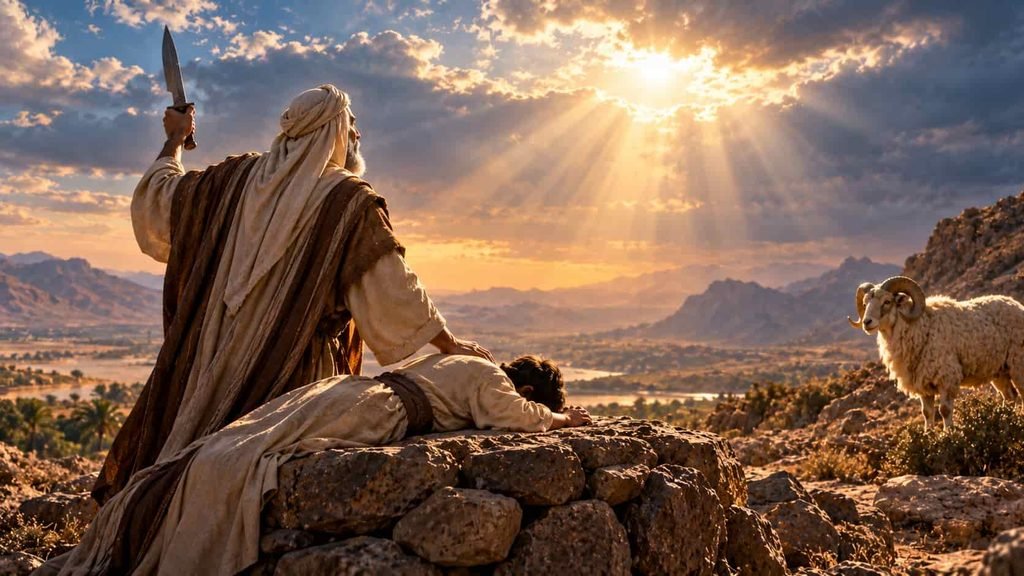
One of the greatest trials in the life of Prophet Ibrahim (Abraham) was the command to sacrifice his beloved son. This extraordinary event became one of the most profound examples of faith, obedience, patience, and complete submission to Allah.
The Qur’an describes this remarkable trial and the response of Ibrahim and his son:
“And he said, ‘Indeed, I am going to my Lord; He will guide me. My Lord, grant me a righteous son.’ So We gave him good tidings of a forbearing boy. Then, when he reached the age to work alongside him, he said, ‘O my son, indeed I have seen in a dream that I must sacrifice you, so consider what you think.’ He said, ‘O my father, do what you are commanded. You will find me, if Allah wills, among the steadfast.’”
Qur’an 37:99–102
This was not an ordinary test. It was a test of the deepest love a father could have for his child, and of the willingness of both father and son to place the command of Allah above everything else.
Ibrahim Asks Allah for a Righteous Son
After Ibrahim declared that he was going toward his Lord, he supplicated:
“My Lord, grant me a righteous son.”
Allah answered his prayer and gave him glad tidings of a forbearing boy.
The son grew until he reached an age at which he could walk, work, and assist his father in his affairs. According to one interpretation mentioned in the transmitted accounts, he was about thirteen years old at the time.
Another interpretation explains the phrase “when he reached the age to work alongside him” as referring to reaching an age when he could participate in righteous deeds and worship.
The Command in the Dream
One night, Ibrahim saw in his dream that he was sacrificing his son.
For the prophets, such a vision was a divine command. Ibrahim therefore did not hesitate or turn away from what he understood to be the command of Allah.
Yet, instead of hiding the matter from his son, Ibrahim spoke to him with gentleness:
“O my son, indeed I have seen in a dream that I must sacrifice you. So consider what you think.”
The response of his son was extraordinary:
“O my father, do what you are commanded. You will find me, if Allah wills, among the steadfast.”
Both father and son had submitted themselves to the will of Allah.
Complete Submission to Allah
The Qur’an then says:
“So when they had both submitted, and he laid him down upon his forehead, We called out to him: ‘O Ibrahim! You have fulfilled the vision.’”
The phrase “when they had both submitted” expresses the complete surrender of both Ibrahim and his son to Allah’s command.
According to one transmitted account, the son asked his father to place his face toward the ground so that Ibrahim would not have to look directly at him and become overwhelmed by the tenderness of a father’s heart.
It is also reported that the son said that he should be placed face down and that Ibrahim should not look at his face, hoping that this would make the trial easier for his father.
The Greatest Trial
Allah says:
“Indeed, this was surely a clear trial.”
The expression has been explained in the transmitted interpretations as referring to an obvious and tremendous test, while also carrying the meaning of a manifest divine favor through which Ibrahim’s rank was elevated.
The sacrifice represented one of the most difficult tests imaginable: a father being commanded to sacrifice his beloved son.
Yet Ibrahim did not place his personal feelings above obedience to Allah.
His son likewise accepted the command with patience and submission.
The Great Sacrifice
Allah then says:
“And We ransomed him with a great sacrifice.”
The transmitted accounts describe the sacrifice as a ram.
Some narrations state that this ram had previously grazed in Paradise for forty years before being sent down as the sacrifice in place of Ibrahim’s son.
A narration attributed to Ibn Abbas identifies it as the same ram whose offering had previously been accepted from Habil (Abel), and which had been kept in Paradise until the appointed time.
Thus, the sacrifice became a sign of Allah’s mercy and a lasting reminder of Ibrahim’s obedience.
Was the Son Ismail or Ishaq?
One of the important discussions surrounding this story concerns the identity of the son whom Ibrahim was commanded to sacrifice.
Different reports have identified the son differently.
A number of transmitted reports identify him as Ismail (Ishmael), while other reports identify him as Ishaq (Isaac).
The text emphasizes that the issue was discussed by Muslim scholars and that reports exist supporting both identifications.
According to the interpretation presented in these narrations, the stronger position is that the son was Ismail (Ishmael).
The Meaning of “I Am the Son of the Two Sacrificed Ones”
A famous statement attributed to the Prophet Muhammad (peace and blessings be upon him) says:
“I am the son of the two sacrificed ones.”
According to the narration from Imam al-Rida (peace be upon him), the two are Ismail ibn Ibrahim and Abdullah ibn Abd al-Muttalib, the father of the Prophet Muhammad (peace and blessings be upon him).
Ismail was the son whom Ibrahim was commanded to sacrifice, but Allah replaced him with a ram.
Abdullah, meanwhile, was the person whose sacrifice was connected to the well-known vow involving Abd al-Muttalib.
This is presented as one explanation for the Prophet’s statement that he was the son of the two sacrificed ones.
Why Is Ishaq Also Described as a Sacrificed One?
The transmitted explanation gives another dimension to the discussion.
According to the account attributed to al-Saduq, although Ismail was the one actually designated for sacrifice, Ishaq later wished that he had been the one commanded to be sacrificed.
He wished that he could demonstrate the same patience and submission to Allah that his brother had demonstrated.
Because Allah knew the sincerity of Ishaq’s intention, he was described among the angels as a sacrificed one because of his sincere willingness and intention.
Thus, according to this interpretation, Ismail was the sacrificed one in reality, while Ishaq attained the reward associated with the sacrifice through his sincere intention.
“The Uncle Is a Father”
The discussion also refers to the Qur’anic usage of the word “father.”
Allah says concerning the descendants of Ya’qub (Jacob):
“We worship your God and the God of your fathers, Ibrahim, Ismail, and Ishaq.”
Ismail was the uncle of Ya’qub rather than his biological father.
The narration explains that an uncle may be referred to as a father in this context, consistent with the statement attributed to the Prophet:
“The uncle is a father.”
This explanation is used in the transmitted discussion concerning the Prophet Muhammad’s statement that he was the son of the two sacrificed ones.
Ibrahim’s Desire for an Even Greater Trial
Another narration attributed to Imam al-Rida (peace be upon him) provides a deeper explanation of the phrase:
“And We ransomed him with a great sacrifice.”
According to this narration, when Allah commanded Ibrahim to sacrifice a ram instead of Ismail, Ibrahim wished that he had actually sacrificed his son.
He wished to experience the full pain and sacrifice of a father who gives his most beloved child in obedience to Allah.
Allah then asked Ibrahim:
“Who among My creation is most beloved to you?”
Ibrahim answered that he had no creation more beloved to him than Muhammad (peace and blessings be upon him).
Allah then asked whether Muhammad was more beloved to him than himself.
Ibrahim answered that Muhammad was more beloved to him.
He was then asked whether the children of Muhammad were more beloved to him than his own children.
Ibrahim answered that the children of Muhammad were more beloved to him.
The narration then turns toward the future suffering of Imam al-Husayn (peace be upon him).
It describes how a group claiming to belong to the followers of Muhammad would later kill al-Husayn unjustly.
When Ibrahim heard this, the narration describes him as becoming deeply distressed and sorrowful.
According to this account, Allah then compensated Ibrahim for the grief he would have experienced had he personally sacrificed Ismail with the grief he felt concerning the future martyrdom of al-Husayn.
This is presented as one interpretation of Allah’s statement:
“And We ransomed him with a great sacrifice.”
The Meaning of the “Great Sacrifice”
The text also addresses a possible question: if al-Husayn is considered greater in rank than Ismail, how could he be described as a ransom for Ismail?
The explanation given is that the word ransom can also convey the meaning of compensation or substitution.
According to this interpretation, Allah did not mean that al-Husayn was inferior to Ismail and therefore served as a literal substitute for him.
Rather, Ibrahim’s grief and sorrow over the future tragedy of al-Husayn became a substitute for the grief he would have experienced if he had personally sacrificed his son Ismail.
Through this trial, Ibrahim was elevated to an even higher degree among those who receive reward for patience in the face of immense suffering.
Another explanation mentioned in the text is that Ismail became an ancestor of the Prophet Muhammad and his family and the purified Imams. Therefore, had Ismail actually been sacrificed, the consequences would have extended through the blessed lineage that descended from him.
The Final Moment of the Sacrifice
Another transmitted account describes the final moments in detail.
When Ibrahim was alone with Ismail, he told him what Allah had commanded him through the dream.
Ismail then responded with remarkable courage.
He asked his father to:
- strengthen his bonds so that he would not move,
- keep his clothes away from the blood,
- sharpen the knife,
- and perform the sacrifice quickly so that the ordeal would be easier for him.
He understood that death would be difficult and wanted to help his father fulfill the command of Allah.
Ibrahim replied with appreciation for his son’s willingness to assist him in obeying Allah.
Ismail’s Request to His Father
In another narration, Ismail asked Ibrahim to cover his face and bind him.
Ibrahim refused to combine both restraints with the sacrifice, saying in essence that he would not impose both upon his son.
He then laid Ismail down, took the knife, and placed it upon his throat.
Ibrahim raised his head toward the heavens and proceeded with the command.
At that moment, however, the knife did not perform the sacrifice.
The angel Gabriel intervened, and the ram was brought and placed in the position of Ismail.
Then the divine call came:
“O Ibrahim! You have fulfilled the vision.”
The test had been completed.
The Ram of Ibrahim
The ram that replaced Ismail occupies an important place in the transmitted accounts.
It is described as a special creature sent by Allah for this purpose.
Some narrations describe its distinctive appearance and state that it had lived in the gardens of Paradise for many years before being sent down.
Its arrival demonstrated that Allah had never intended the death of Ismail.
The purpose of the command was to test the obedience and submission of Ibrahim and his son.
Once they had demonstrated complete submission, Allah replaced the sacrifice with the ram.
The Sacrifice and the Rites of Hajj
The sacrifice of Ibrahim became connected with the rituals of sacrifice performed during Hajj.
According to the transmitted explanation, animals sacrificed at Mina are understood as continuing the tradition of the sacrifice connected with Ismail.
The event therefore became a lasting symbol of obedience to Allah, patience, and willingness to sacrifice what is most beloved for His sake.
Why Was the Sacrifice Called “Great”?
The description “a great sacrifice” has been understood in several ways in the transmitted accounts.
It refers to the greatness of the sacrifice itself, its divine origin, its connection to Ibrahim’s trial, and its enduring significance.
The ram was not merely an animal replacing Ismail.
It became a symbol of divine mercy after one of the greatest tests faced by a prophet.
A Remarkable Lesson in Faith
The story of Ibrahim and Ismail teaches that true faith is demonstrated not only through words but through complete submission.
Ibrahim loved his son deeply, yet his love did not prevent him from obeying Allah.
Ismail loved his father and valued his own life, yet he accepted Allah’s command with patience.
Neither father nor son knew how the trial would end.
They simply trusted Allah.
And when they had demonstrated their submission, Allah’s mercy came.
The Spiritual Meaning of the Story
The story contains several profound lessons:
1. Complete Trust in Allah
Ibrahim did not allow fear to overcome his trust in Allah.
2. Patience During Severe Trials
Both Ibrahim and Ismail demonstrated extraordinary patience.
3. Obedience to Allah
The event illustrates the meaning of submitting one’s will to the command of Allah.
4. The Mercy of Allah
Allah did not allow Ismail to be sacrificed. Instead, He provided the ram as a ransom.
5. Sincere Intention Has Great Value
The account concerning Ishaq emphasizes the importance of sincere intention. Even though he was not actually sacrificed, his willingness to accept the command was regarded as worthy of reward.
6. Sacrifice Is Connected With Faith
The sacrifice became an enduring symbol of devotion and obedience to Allah.
The Legacy of Ibrahim
Allah says:
“And We left for him among later generations: ‘Peace upon Ibrahim.’”
Ibrahim’s trial became part of his lasting legacy.
Allah also says:
“Thus do We reward the doers of good. Indeed, he was among Our believing servants.”
The story of the sacrifice therefore does not end with the ram.
It continues through generations as a reminder that sincere faith requires trust, patience, courage, and submission to Allah.
Conclusion
The story of Prophet Ibrahim and the sacrifice of his son is one of the most powerful stories of faith in Islamic tradition.
Ibrahim received a command that tested the deepest bond of the human heart. His son, Ismail, responded with patience and submission. Together, they demonstrated that obedience to Allah can rise above even the strongest human attachment.
Allah then replaced Ismail with a great sacrifice and honored Ibrahim for fulfilling the vision.
The story remains a profound reminder that when a believer sincerely submits to Allah, divine mercy can emerge from the greatest trial.
For Ibrahim, the sacrifice became a lasting symbol of faith.
For Ismail, it became a testimony to patience.
And for generations of believers, it remains a reminder that true submission begins when the heart trusts Allah completely.
← Previous Article: [Prophet Ibrahim (Abraham): His Virtues and Why Allah Chose Him as His Friend]
→ Next Article: [The Next Story of Prophet Ibrahim (Abraham)]