
Introduction
The story of Prophet Ibrahim (Abraham), peace be upon him, is closely connected with the history of Makkah, the Sacred House, Hagar, Prophet Ismail (Ishmael), and the rites of Hajj.
According to the narrations presented in this account, Allah commanded Ibrahim to take Hagar and his son Ismail to the sacred land of Makkah. What initially appeared to be a barren and uninhabited valley would later become one of the most sacred places on earth.
The story includes the emergence of Zamzam, the arrival of the Jurhum tribe, the building of the Kaaba by Ibrahim and Ismail, the Black Stone, the Maqam of Ibrahim, and Ibrahim’s call to the people to perform Hajj.
Ibrahim Takes Hagar and Ismail to Makkah
The narrations describe how Ibrahim, peace be upon him, was instructed by Allah to take Hagar and her son Ismail to the sacred land.
Ibrahim traveled with Hagar and the young Ismail until they reached a valley where there were no people, no water, and no crops.
Hagar asked Ibrahim why he was leaving them in such a deserted place. Ibrahim explained that it was Allah who had commanded him to leave them there and that Allah would take care of them.
As Ibrahim turned away, he prayed:
“Our Lord, I have settled some of my descendants in an uncultivated valley near Your Sacred House, our Lord, so that they may establish prayer. So make the hearts of people incline toward them and provide them with fruits so that they may be grateful.”
This prayer became part of the remarkable story of how Makkah would eventually become a place toward which the hearts of millions of people would turn.
Hagar Searches for Water
After Ibrahim left, the young Ismail became thirsty.
Hagar began searching for water and went to the area between Safa and Marwah. She climbed Safa and looked across the valley, hoping to find someone who could help them.
When she saw what appeared to be water in the distance, she hurried toward it, only to discover that it was a mirage.
She then returned toward Safa and continued searching.
According to the narration, Hagar repeated this journey seven times between Safa and Marwah. During the seventh journey, while she was at Marwah, she saw water emerging beneath the feet of Ismail.
This event is connected in the narration with the origin of the ritual of walking between Safa and Marwah during Hajj.
The Miracle of Zamzam
When Hagar saw the water flowing beneath Ismail, she quickly gathered sand around it to contain the water because it was flowing.
The narration explains that this was the beginning of Zamzam.
The appearance of water changed the valley completely. Birds and animals began gathering around the water, attracting the attention of travelers and nearby tribes.
The Jurhum tribe noticed the birds gathering around the area and followed them until they discovered Hagar and Ismail.
They asked Hagar who she was and why she and the child were living there. She explained that she was the mother of the son of Ibrahim, the close friend of Allah.
The people of Jurhum then asked permission to settle near them. Hagar sought Ibrahim’s permission, and he allowed them to stay. As a result, the previously deserted valley began to develop into a place where people could live.
Ismail Grows Up in Makkah
Ismail grew up among the people of Jurhum.
According to the narration, members of the tribe gave Ismail sheep, and Hagar and Ismail lived from them.
As Ismail grew older and reached maturity, Allah commanded Ibrahim to build the Sacred House.
This marked the beginning of one of the most important stages in the history of Makkah.
Building the Kaaba
Allah commanded Ibrahim to build the House.
The narration states that Ibrahim asked Allah where the Sacred House should be built. Allah directed him to the location associated with the sacred structure that had existed before.
Allah then sent the angel Jibril (Gabriel), peace be upon him, who showed Ibrahim the location of the House.
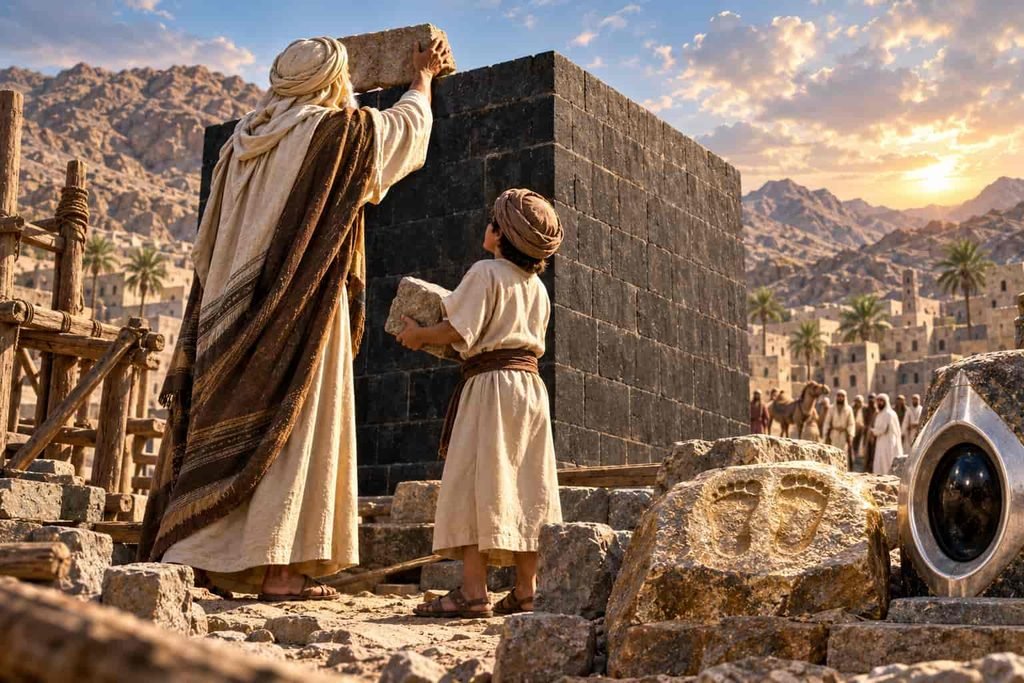
Ibrahim and Ismail began building the Kaaba together. The foundations were raised, and Ismail helped his father during the construction.
The narration also connects the Black Stone with the building of the Sacred House. It describes the stone as having originally been bright and white before becoming black.
The Qur’an describes the command given to Ibrahim and Ismail:
“Purify My House for those who perform Tawaf, those who remain there in worship, and those who bow and prostrate.”
The Maqam of Ibrahim
The story also explains the connection between Ibrahim and the Maqam of Ibrahim.
During one of Ibrahim’s visits to Ismail, he stood at the Maqam while Ismail’s wife assisted him. The narration describes how Ibrahim’s footprints remained upon the stone.
This became associated with the Maqam of Ibrahim, one of the well-known sacred places connected with the Kaaba.
The Qur’an says:
“And take the standing place of Abraham as a place of prayer.”
The Maqam therefore remains an important part of the sacred history of Makkah.
The Black Stone
Several narrations in the source discuss the origin of the Black Stone.
One narration attributed to Imam al-Sadiq, peace be upon him, states that the Black Stone was sent down from Paradise to Adam. Another narration describes a white stone associated with the Sacred House and explains that it became dark because of the sins of the descendants of Adam.
The narrations also mention that the foundations of the House were established and that Ibrahim and Ismail built the Sacred House upon them.
The First Covering of the Kaaba
The account also contains a narration concerning the covering of the Kaaba.
When Ibrahim and Ismail had built the House, Ismail’s wife suggested placing curtains over its doors.
They prepared coverings for the doors, and later she suggested covering the entire Kaaba.
She gathered wool and worked with her people to prepare the covering. When the season of pilgrimage arrived, one side of the Kaaba had not yet been completely covered, so they used available material to cover it.
The Arab tribes admired the appearance of the House and began bringing gifts and offerings to it.
The Well of Zamzam
The narrations further explain that Ismail complained to Ibrahim about the lack of water.
Allah then instructed Ibrahim to dig a well from which the people could drink.
Ibrahim dug the well of Zamzam, and the narration describes water emerging from different parts of the well.
Jibril then told Ibrahim to drink from the water and pray for blessing for his son.
Zamzam consequently became one of the most famous sacred features of Makkah and remains closely connected with the story of Hagar and Ismail.
Ibrahim’s Call to Hajj
After the Sacred House had been completed, Ibrahim was commanded to call the people to Hajj.
He stood at the Maqam and called out to the people, inviting them to come for pilgrimage.
According to the narration, his call was heard beyond the people physically present at that time, reaching those who would come to Hajj in later generations.
Another narration states that Allah commanded Ibrahim:
“And proclaim to mankind the pilgrimage; they will come to you on foot and on every lean camel, coming from every distant mountain pass.”
Thus, the call of Ibrahim became connected with the continuing pilgrimage to the Sacred House.
The Origin of Safa and Marwah
The journey of Hagar between Safa and Marwah is also connected with the rituals of Hajj.
Hagar’s search for water was driven by her concern for her son. She moved repeatedly between the two locations until Allah brought forth the water of Zamzam.
The narration states that this became the origin of the practice of Sa’i, the journey between Safa and Marwah.
This part of the story highlights Hagar’s perseverance, determination, and trust in Allah.
Ibrahim and the Rites of Hajj
The narrations in the source connect several rituals and locations of Hajj with the story of Ibrahim.
These include:
- Safa and Marwah
- Mina
- Arafat
- Muzdalifah
- The Jamarat
- The Kaaba
- The Maqam of Ibrahim
One narration explains that the Jamarat became associated with Ibrahim’s encounter with Satan, when Ibrahim was instructed to repel him by throwing seven stones.
Another narration explains the name Arafat in connection with Jibril’s instruction to Ibrahim to recognize his rites and acknowledge his shortcomings.
The source also relates the name Mina to an event in which Jibril asked Ibrahim to make a wish, and Ibrahim wished that his son Ismail would be replaced by a ram as a sacrifice.
The Meaning of Ibrahim’s Prayer for Makkah
After completing the building of the Sacred House, Ibrahim prayed:
“My Lord, make this a secure city and provide its people with fruits.”
The narration explains this prayer as including a request that Allah make the Sacred House beloved to people’s hearts so that they would continue returning to it.
This prayer reflects one of the central themes of the story: the transformation of a barren valley into a place of worship and a destination for people from distant lands.
Prophet Ibrahim, Ismail, and Their Legacy
The relationship between Ibrahim and Ismail is central to the story of the Sacred House.
Together, father and son participated in building the Kaaba and preparing it for worship.
The story presents their obedience to Allah, their patience, and their willingness to carry out His commands.
The Sacred House would later become the direction of prayer for Muslims and the destination of millions of pilgrims.
Their work therefore became part of a lasting legacy of worship that continued through generations.
Lessons from the Story of Ibrahim, Hagar, and Ismail
The story contains many important lessons:
1. Trust in Allah
Hagar remained in a place without water or people because she trusted that Allah would not abandon her and her son.
2. Patience in Difficult Circumstances
Hagar’s search for water demonstrates perseverance in the face of hardship.
3. Allah Can Bring Relief from Unexpected Places
The appearance of Zamzam transformed a barren valley into a place where people could settle.
4. Obedience and Cooperation
Ibrahim and Ismail worked together to build the Sacred House according to Allah’s command.
5. Worship Can Leave a Lasting Legacy
The work of Ibrahim and Ismail became connected with Hajj, one of the greatest acts of worship in Islam.
6. The Sacred House Is a Place of Return
Ibrahim prayed that Allah would make people’s hearts incline toward the Sacred House and cause people to return to it.
Conclusion
The story of Prophet Ibrahim, Hagar, and Ismail is one of the most important stories connected with the history of Makkah and the Sacred House.
From the moment Ibrahim left Hagar and young Ismail in the barren valley, a remarkable chain of events began. Hagar’s search for water led to the appearance of Zamzam. The arrival of the Jurhum tribe transformed the valley into a place of settlement, and when Ismail grew older, Allah commanded Ibrahim and Ismail to build the Kaaba.
The Sacred House then became the center of pilgrimage, and Ibrahim was commanded to call humanity to Hajj.
The story reminds us of the importance of faith, patience, obedience, perseverance, and trust in Allah. It also shows how an act carried out in obedience to Allah can leave a legacy that continues for generations.
📖 Continue Reading the Stories of the Prophets
Read the Next Article →