
Introduction
Prophet Lot (Lut), peace be upon him, was one of the prophets sent by Allah to warn a people who had fallen into serious corruption and sinful behavior.
The Qur’an presents Lot as a sincere servant of Allah who called his people toward purity, righteousness, and obedience. Yet his people rejected his warning and continued upon their path until the punishment of Allah came upon them.
Allah says:
“And Lot, when he said to his people, ‘Do you commit an immorality that no one has preceded you with among the worlds? Indeed, you approach men with desire instead of women. Rather, you are a transgressing people.’”
His story is a powerful reminder of the consequences of persistent wrongdoing, but also of the protection Allah grants to His faithful servants.
Who Was Prophet Lot?
According to the transmitted accounts, Lot was related to Prophet Ibrahim (Abraham), peace be upon him.
Some reports describe him as the son of Haran, son of Tarikh, and the brother’s son of Ibrahim. Other reports describe him as Ibrahim’s maternal cousin and mention that Sarah, the wife of Ibrahim, was Lot’s sister.
Whatever the precise family relationship described in the different reports, the important point is that Lot was closely connected to Ibrahim and became one of the prophets who carried the message of Allah.
The People of Lot
The people among whom Lot lived had become known for widespread corruption.
The Qur’an describes their particular transgression and records Lot’s attempt to warn them.
They did not merely commit individual sins. According to the transmitted accounts, their wrongdoing became public and organized, and they even harmed travelers who passed through their settlements.
Some reports state that they would attack travelers, throw stones at them, take their property, and create fear along the roads.
Their behavior eventually became so notorious that travelers avoided their settlements.
Corruption in Their Gatherings
The Qur’an also refers to the wrongdoing committed by the people of Lot in their public gatherings:
“And you commit evil in your gatherings.”
The transmitted explanations give several interpretations of this verse.
Among them is an account that they behaved without modesty or shame in their gatherings.
Other reports describe immoral acts taking place openly in their assemblies.
These accounts emphasize that their corruption was not hidden. It had become part of the public life of their society.
Lot Warns His People
Lot spent many years calling his people toward Allah.
One transmitted report states that he remained among them for thirty years, inviting them to worship Allah and abandon their sinful behavior.
He was described as generous and hospitable. When travelers arrived, he would welcome them and provide them with food and shelter.
This contrasted sharply with the behavior of his people.
While Lot honored guests, his people sought to frighten and mistreat them.
They even warned Lot not to interfere with their behavior.
The Generosity of Lot
One of the important characteristics emphasized in the transmitted account is the generosity of Lot.
He welcomed guests even though he knew that doing so could place him in danger.
His people were aware of his hospitality and attempted to use it against him.
Lot sometimes concealed the presence of guests because he feared that his people would attack them.
Yet he continued to fulfill the responsibility of hospitality and protect those who sought refuge with him.
The Connection Between Ibrahim and Lot
The punishment of the people of Lot was repeatedly delayed according to the transmitted narration because of the affection and concern of Ibrahim and Lot.
When Allah finally decreed that the punishment would come, the angels were sent first to Ibrahim.
They came with good news before proceeding toward the people of Lot.
The Qur’an describes the arrival of the messengers:
“And indeed, Our messengers came to Ibrahim with good news. They said, ‘Peace.’ He said, ‘Peace.’ Then he brought a roasted calf.”
The Angels Visit Ibrahim
The visitors appeared as guests, and Ibrahim welcomed them.
He prepared food for them, but they did not eat.
This caused Ibrahim to become afraid.
The visitors then reassured him and informed him that they had been sent by Allah.
They also brought him glad tidings of a son.
The transmitted account identifies this son as Ishaq (Isaac) and gives the further glad tidings of Ya’qub (Jacob).
Sarah was astonished by the news because of her advanced age.
She said, in meaning:
“How can I have a child while I am an old woman and this is my husband, an old man?”
The angels reassured her that the command of Allah was beyond ordinary expectations.
The Angels Explain Their Mission
After Ibrahim had received the glad tidings, the angels explained why they had come.
They had been sent to the people of Lot because the punishment of Allah had been decreed against them.
Ibrahim immediately thought of Lot.
He asked:
“Indeed, Lot is there.”
The angels reassured him that they knew who was in the city and that they would save Lot and his family, except for his wife.
This demonstrated the mercy of Allah toward His believing servants.
Ibrahim Pleads for the Believers
The transmitted account describes Ibrahim asking whether the punishment would still come if believers were present among the people.
He asked about one hundred believers, then fifty, then ten, and finally even one believer.
The answer was that the believers would not be destroyed.
This corresponds with the meaning of the Qur’anic statement that the messengers would save Lot and his family except his wife.
The account emphasizes that divine punishment does not overlook the innocent believer.
The Angels Arrive at the House of Lot
The angels then traveled to Lot.
They arrived in the form of young men.
Lot did not initially know who they were.
When he saw them, he immediately became concerned because he knew what his people were capable of doing.
He warned the visitors that the people of the town were wicked and that they would harm them.
The visitors nevertheless asked him to provide them with shelter for the night.
Lot welcomed them into his home.
Lot’s Wife
Lot informed his wife that guests had arrived and asked her to keep their presence secret.
According to the transmitted account, she had an arrangement with the people of the town.
When guests arrived during the day, she would signal them by creating smoke above the roof. At night, she would light a fire.
When the angels entered Lot’s home, she gave the signal.
The people of the town soon learned that guests were staying with Lot.
They rushed toward his house.
The People Surround Lot’s House
The people came to Lot’s house demanding access to his guests.
They reminded him of their previous warning not to interfere with outsiders.
Lot attempted to protect his guests and called them toward what was lawful and pure.
The transmitted interpretation explains Lot’s words:
“These are my daughters; they are purer for you.”
According to this interpretation, Lot was directing them toward lawful marriage and away from the immoral behavior they had adopted.
The people rejected his offer.
They replied that they already knew what they wanted.
Lot’s Distress
At this moment, Lot became deeply distressed.
He said:
“If only I had strength against you, or could take refuge in a strong support.”
Lot felt that he had no human force capable of protecting his guests from the crowd outside his house.
But he did not know that the strongest protection was already inside his home.
The visitors were not ordinary men.
They were angels sent by Allah.
The True Identity of the Visitors
The angels finally revealed their identity.
One of them was Jibril (Gabriel).
He told Lot that they were messengers of his Lord and that the people outside would not be able to harm him.
Jibril then struck the faces of the attackers with his wing, causing them to lose their sight.
The Qur’an refers to this event:
“And indeed, they demanded from him his guests, but We blinded their eyes. So taste My punishment and warning.”
The people suddenly realized that the punishment had begun.
The Command to Leave
The angels then instructed Lot:
“So set out with your family during a portion of the night and let none of you look back, except your wife.”
Lot was commanded to leave with his family.
His wife, however, would not be saved because she had sided with the people and remained connected to their wrongdoing.
The transmitted account describes her turning back, after which she was struck by the punishment.
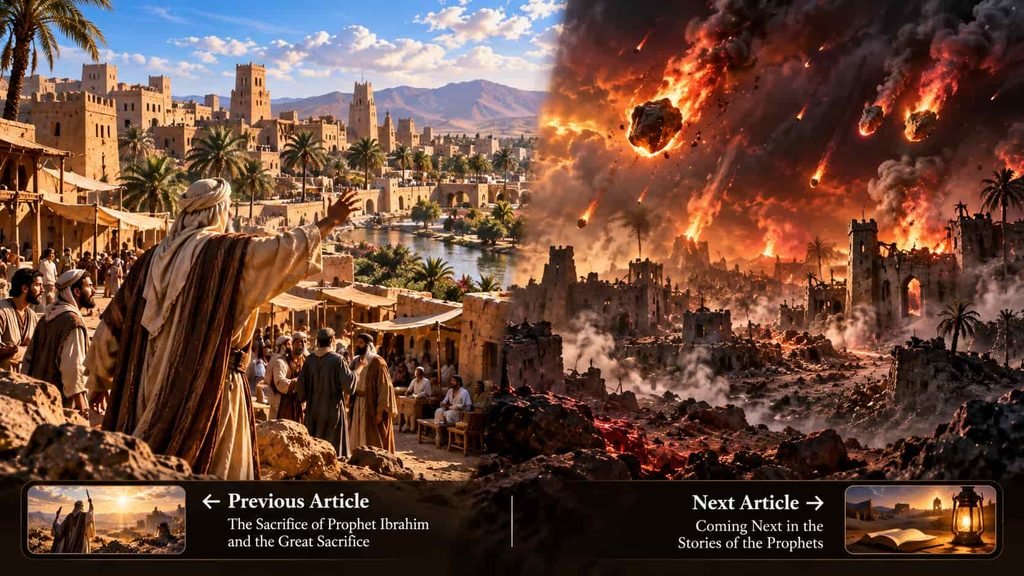
The Destruction of the City
At dawn, the punishment came.
According to the detailed transmitted narration, four angels were positioned around the city.
The city was lifted from beneath the earth and raised upward before being overturned.
Then stones of baked clay were sent down upon the people.
Allah says:
“So when Our command came, We turned its highest part upside down and rained upon them stones of layered hard clay.”
The destruction was complete.
A Sign for Those Who Reflect
The Qur’an repeatedly presents the destruction of the people of Lot as a lesson.
Their story demonstrates that when corruption becomes widespread and people persist in wrongdoing despite clear warnings, punishment can eventually come.
At the same time, the story shows that Allah protects His faithful servants.
Lot was surrounded by people who rejected his message, yet Allah rescued him.
The Cities of the People of Lot
The transmitted accounts give different names and numbers for the cities associated with the people of Lot.
One account mentions four cities, while another historical report mentions five.
The names recorded in the source include Sodom and several other settlements.
These differences are part of the transmitted historical accounts surrounding the story.
The People of Lot and the Travelers
One of the notable themes in the source is the way the people of Lot treated travelers.
Their settlement stood along a route used by travelers, and hospitality was initially practiced there.
However, according to the transmitted narration, their excessive concern over feeding travelers eventually led them toward miserliness and corruption.
Their refusal to welcome travelers contributed to a society in which strangers became targets of abuse.
This contrasts strongly with the character of Lot, who remained generous and hospitable.
The Influence of Satan
Another transmitted account describes Satan’s role in leading the people further into corruption.
According to this narration, Satan first appeared in a deceptive form and gradually encouraged them toward immoral behavior.
What began as an individual act eventually spread throughout the community.
The people then began targeting travelers and others who passed through their land.
The account presents this as an example of how wrongdoing can begin with a small group and eventually become normalized throughout a society.
Lot Continues His Mission
Despite the corruption surrounding him, Lot continued to warn his people.
He did not abandon his mission.
He repeatedly called them to righteousness and warned them of the consequences of their actions.
But they rejected his warnings.
Eventually, they threatened him and demanded that he stop speaking against their behavior.
Lot therefore became increasingly isolated among his people.
The Arrival of the Angels in the Final Trial
In another transmitted account, Jibril, Mika’il, and Israfil were sent to Lot in the form of young men.
They passed by Lot while he was working.
Lot immediately recognized that their presence could place them in danger.
He warned them about the people of the city and asked them to remain outside until darkness.
He then attempted to protect them by taking them into his home.
The People Demand the Guests
When the people learned that the visitors were inside Lot’s house, they gathered around the home.
Lot pleaded with them not to disgrace him through their actions.
They insisted on their demand.
Lot again expressed his helplessness:
“If only I had strength against you, or could take refuge in a strong support.”
The narration then reveals that the strongest support was already with him: Jibril and the angels of Allah.
The Miracle of Protection
When the attackers attempted to break into Lot’s house, Jibril intervened.
He struck their faces, and they became blind.
The attackers could no longer see.
The angels then instructed Lot to leave immediately.
They informed him that the appointed time of their destruction would be the morning.
The Final Escape
Lot was instructed to take his daughters and leave.
The transmitted narration describes the angels providing a path for Lot and his family to escape the city.
His wife, however, turned back and was struck by the punishment.
The believing family was therefore separated from the people who had rejected Allah’s command.
The Punishment at Dawn
When morning came, the angels carried out the divine command.
The city was overturned, and stones were rained upon its inhabitants.
The transmitted narration describes the angels lifting the settlement and overturning it.
The punishment was followed by a rain of stones from baked clay.
The Qur’an presents the event as a clear warning:
“And We rained upon them a rain. So see how was the end of the criminals.”
The Importance of Moral Responsibility
The story of Lot also emphasizes personal responsibility.
Not everyone living in a corrupt society necessarily shares the same fate.
The source specifically describes the presence of believers who were saved.
Lot himself continued to believe and call others toward Allah despite living among people who opposed him.
His wife, however, did not follow him in faith.
Her presence in Lot’s household did not save her.
Lessons from the Story of Prophet Lot
1. Never Abandon the Truth
Lot continued his mission even when his people rejected him.
2. Protecting Guests Is a Noble Duty
Lot repeatedly risked his own safety to protect those who sought refuge with him.
3. Corruption Can Become Socially Normalized
The story warns against allowing wrongdoing to spread until an entire society begins treating it as normal.
4. Allah Protects His Believing Servants
Although Lot appeared helpless, Allah sent His angels to protect him.
5. Wealth and Social Power Cannot Prevent Divine Justice
The people of Lot possessed strength and influence within their society, but none of it could protect them when the divine punishment arrived.
6. Family Relationship Alone Does Not Guarantee Salvation
Lot’s wife was his spouse, yet she was not among those who were saved because of her stance toward the people.
7. Patience Is Essential for the Prophets
Lot endured years of rejection while continuing to call his people toward Allah.
The Legacy of Prophet Lot
The story of Prophet Lot remains one of the powerful narratives of the Qur’an and Islamic tradition.
It describes a prophet who faced a society deeply immersed in corruption, yet remained committed to his mission.
He welcomed strangers, defended his guests, warned his people, and continued calling them toward Allah.
When they rejected every warning and persisted in their actions, Allah’s command finally came.
Lot and the believers were rescued, while the people who rejected the warning were destroyed.
Conclusion
The story of Prophet Lot (Lut), peace be upon him, is a story of faith, patience, hospitality, courage, and divine justice.
Lot stood almost alone against a society that had abandoned righteousness. Yet he did not surrender his principles.
When the final trial came, Allah demonstrated that apparent weakness does not mean the absence of divine support.
The angels came to Lot’s house, protected him and his guests, and guided him to safety.
The destruction of his people became a lasting lesson for later generations.
The story reminds believers that righteousness may sometimes require standing against the majority, protecting what is right, and trusting Allah even when the path appears difficult.
Previous Article
← Prophet Ibrahim (Abraham): The Sacrifice of Ismail and the Great Sacrifice
Next Article
Next Article → Coming next in the Stories of the Prophets series.