
Introduction
The story of Dhul-Qarnayn is one of the remarkable stories mentioned in the Qur’an. Allah describes him as a powerful servant who was given authority in the land and provided with the means to accomplish great things.
Allah says:
“And they ask you about Dhul-Qarnayn. Say, ‘I will recite to you about him a report.’ Indeed, We established him upon the earth, and We gave him to everything a means. So he followed a means.”
He traveled across the earth, reaching the farthest lands in the east and west. He encountered different peoples, witnessed remarkable signs, and eventually reached a people who lived between two mountains and were threatened by Gog and Magog (Ya’juj and Ma’juj).
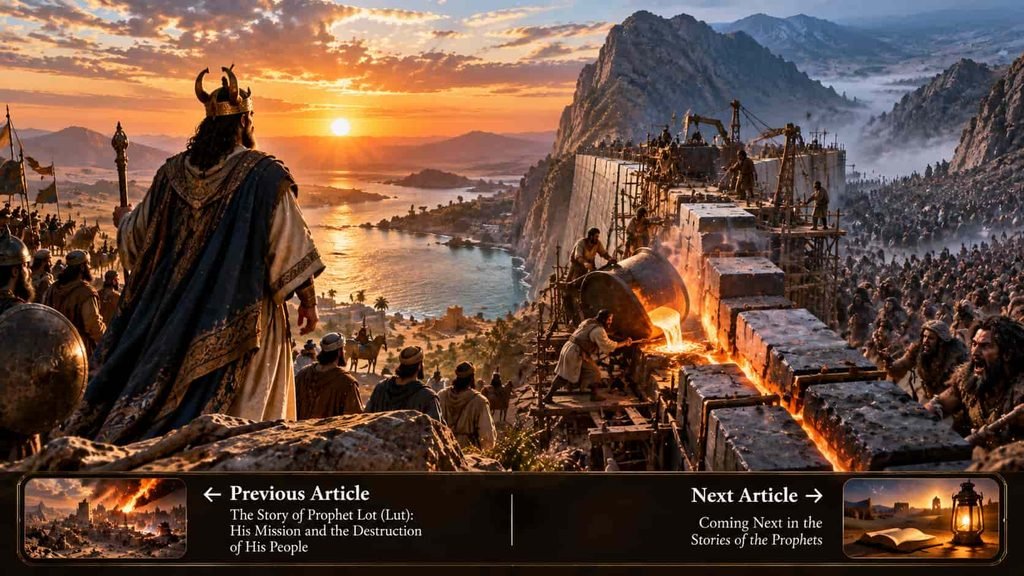
There, Dhul-Qarnayn built an enormous barrier of iron and molten copper to protect the people from their attacks.
The transmitted accounts also contain fascinating descriptions of Dhul-Qarnayn’s character, his encounters with righteous people, his relationship with al-Khidr, his journeys through darkness, and his reflections on power, wealth, and the destiny of humanity.
Who Was Dhul-Qarnayn?
The transmitted reports give different descriptions of Dhul-Qarnayn.
One account states that his name was Ayyash, and that he was among the earliest kings after Prophet Nuh (Noah), peace be upon him.
Another narration attributed to Imam Ali (peace be upon him) describes Dhul-Qarnayn not as a prophet or an ordinary king, but as a servant of Allah who loved Allah, and whom Allah loved.
According to this account, he was sent to his people, suffered great trials, and was eventually given authority throughout the earth.
The text therefore presents Dhul-Qarnayn primarily as a righteous servant who was supported and empowered by Allah.
Was Dhul-Qarnayn a Prophet or a King?
One of the important questions discussed in the transmitted sources is whether Dhul-Qarnayn was a prophet.
Some interpretations considered the possibility that he was a prophet because Allah communicated with him and granted him extraordinary authority.
However, other reports explicitly state that he was neither a prophet nor a king in the ordinary sense, but a righteous servant who loved Allah and was loved by Him.
Al-Saduq is quoted as expressing the view that Dhul-Qarnayn was not a prophet but a righteous servant who loved Allah, and Allah loved him.
Thus, this article follows the interpretation emphasized in the source: Dhul-Qarnayn was a righteous servant of Allah, granted extraordinary authority and means.
Allah Gave Him Power and Means
The Qur’an says:
“Indeed, We established him upon the earth, and We gave him to everything a means.”
The transmitted interpretation explains that Allah gave Dhul-Qarnayn knowledge, ability, tools, and the means by which he could accomplish what he intended.
A narration attributed to Imam Ali states that Allah subjected the clouds to him, allowing him to travel upon them, and provided him with means and light so that day and night were alike for him.
This was part of the divine empowerment granted to him.
The Journey to the West
Dhul-Qarnayn first traveled toward the west.
Eventually, he reached the farthest inhabited region in that direction.
The Qur’an says:
“Until, when he reached the setting place of the sun, he found it setting in a spring of dark mud.”
The transmitted explanation clarifies that this does not mean that the sun literally entered a pool of water.
Rather, from the position of the observer, the sun appeared to set in the water, just as someone at sea may see the sun apparently setting into the water.
The spring is described as having dark mud, and another interpretation describes it as hot.
The source also mentions a report attributed to Ka’b stating that the sun was described in the Torah as setting in water and mud.
Dhul-Qarnayn’s Justice
When Dhul-Qarnayn reached the western people, Allah gave him a choice:
“Either you punish them, or else adopt among them goodness.”
Dhul-Qarnayn responded with justice:
“As for the one who wrongs, we will punish him, then he will be returned to his Lord, and He will punish him with a terrible punishment. But as for the one who believes and does righteousness, he will have the best reward, and we will speak to him from our command with ease.”
His response demonstrates that his authority was not merely military power.
He understood responsibility and justice.
Those who committed wrongdoing would face consequences, while those who believed and acted righteously would be treated with kindness.
The Righteous People Dhul-Qarnayn Met
One of the fascinating stories in the source describes Dhul-Qarnayn meeting a man who was praying while Dhul-Qarnayn passed by with his army.
Dhul-Qarnayn was surprised that the man was not frightened by the presence of such a large army.
The man replied that he had been speaking privately with One whose army was greater, whose authority was stronger, and whose power was greater than that of Dhul-Qarnayn.
He explained that if he turned his attention away from Allah to fear Dhul-Qarnayn, he would lose what he was seeking from his Lord.
The response impressed Dhul-Qarnayn.
Four Things That Cannot Be Guaranteed
Dhul-Qarnayn asked the man whether he would accompany him.
The man agreed, but only if Dhul-Qarnayn could guarantee four things:
- everlasting comfort,
- health without illness,
- youth without old age,
- and life without death.
Dhul-Qarnayn replied that no human being could guarantee such things.
The man then explained that these things belong only to the One who possesses them completely.
The encounter reminded Dhul-Qarnayn that worldly authority cannot overcome the limitations of human existence.
The Wise Man and Four Pairs of Opposites
Dhul-Qarnayn later encountered a learned man who asked him about several pairs of things.
He asked about:
- two things that had remained standing since their creation,
- two things that were different,
- two things that were continually moving,
- and two things that were opposed to one another.
Dhul-Qarnayn answered:
The sun and moon were the two that move.
Night and day were the two that differ.
Life and death were the two that oppose one another.
The encounter demonstrated his wisdom and understanding.
The Man Who Examined Human Skulls
During another journey, Dhul-Qarnayn encountered an elderly man turning over the skulls of the dead.
Dhul-Qarnayn asked why he did this.
The man answered that he wanted to distinguish the noble from the lowly and the rich from the poor.
But after examining the skulls for twenty years, he had been unable to find any difference.
Dhul-Qarnayn understood the lesson.
In death, worldly status disappears.
The skull of a ruler and the skull of an ordinary person ultimately reveal the same human reality.
The People Who Remembered Death
Dhul-Qarnayn eventually encountered a remarkable community described as knowledgeable and righteous.
He noticed that they placed the graves of their dead beside their homes.
When he asked why, they explained that they wanted death to remain constantly in their hearts so that they would never forget it.
Their homes also had no doors because, according to their explanation, they had no thieves and no people who could be suspected of theft.
They lived without fear of one another.
A Society Built on Justice
Dhul-Qarnayn continued asking them why they had no rulers.
They replied that they did not oppress one another.
He asked why they had no judges.
They replied that they did not quarrel.
He asked why they had no kings competing for greater wealth and status.
They answered that they did not seek superiority over one another.
They lived through mutual generosity and compassion.
They did not insult or kill one another because they had disciplined their natural impulses.
They did not lie, deceive, or backbite.
They shared their wealth fairly, so they had no destitute people among them.
They were humble rather than harsh.
They practiced justice, constantly sought forgiveness, and trusted Allah rather than relying on omens or stars.
The Source of Their Righteousness
Dhul-Qarnayn asked whether these practices were inherited from their ancestors.
They answered that they had found their ancestors showing mercy toward the poor, helping those in need, forgiving those who wronged them, treating those who harmed them with kindness, seeking forgiveness for sinners, maintaining family ties, fulfilling trusts, speaking truthfully, and avoiding lies.
Because of these practices, Allah had improved their condition.
This part of the story presents a powerful picture of a society whose stability was connected with justice, honesty, compassion, and trust in Allah.
Dhul-Qarnayn and the Angel
Another transmitted account describes Dhul-Qarnayn entering a land of darkness.
There he encountered an angel standing upon a great mountain.
The angel explained that every mountain created by Allah had a connection to this mountain, and that when Allah wished to cause an earthquake in a city, the angel was commanded to move the corresponding connection.
This account emphasizes the immense and unseen order of creation described in the transmitted traditions.
The Search for the Spring of Life
One of the most famous stories associated with Dhul-Qarnayn concerns the Spring of Life.
Dhul-Qarnayn was told that there was a spring in the earth whose water could preserve the life of whoever drank from it.
He gathered his companions and included al-Khidr among them.
Each man was given a fish and instructed to wash it at a different spring.
When al-Khidr washed his fish, it came to life and slipped into the water.
Al-Khidr followed it and drank from the spring.
The other men returned to Dhul-Qarnayn without finding the spring.
When Dhul-Qarnayn learned what had happened, he realized that al-Khidr had been the one who reached it.
The account therefore presents al-Khidr as the one who attained the water of life while Dhul-Qarnayn did not.
Dhul-Qarnayn and the Great Darkness
Another account describes Dhul-Qarnayn traveling beyond the barrier and entering deep darkness.
There he encountered an angel standing on a massive mountain.
The angel asked him how he had managed to reach a place that no human before him had reached.
Dhul-Qarnayn replied that the same One who had given the angel strength had given him strength.
The angel then explained the importance of the great mountain in the structure of the earth according to the transmitted account.
Dhul-Qarnayn eventually returned to his companions and continued his journey.
The Journey Toward the East
After reaching the western regions, Dhul-Qarnayn turned toward the east.
He traveled through different lands and encountered many nations.
The source describes him as carrying out his mission among the peoples he encountered and continuing toward the regions where the sun rises.
The Qur’an describes his eastern journey as another stage in his great travels.
The People Who Could Barely Understand Speech
Eventually, Dhul-Qarnayn reached a people who could barely understand speech.
They lived in a region where another great threat existed between them and other lands.
That threat was Gog and Magog — Ya’juj and Ma’juj.
The people asked Dhul-Qarnayn to help protect them.
Who Are Gog and Magog?
The transmitted accounts describe Gog and Magog as a powerful people who caused enormous destruction.
They are described as numerous and aggressive, spreading across the land and consuming what they encountered.
The source contains several different descriptions of their appearance, numbers, origin, and characteristics.
One narration attributes their origin to the descendants of Japheth, son of Noah.
Other reports provide different descriptions.
These details belong to the transmitted accounts surrounding the story and vary among the narrations.
The People Ask Dhul-Qarnayn for Help
The people told Dhul-Qarnayn:
“Indeed, Gog and Magog are causing corruption in the land. So may we assign for you an expenditure that you might make between us and them a barrier?”
They offered him payment.
But Dhul-Qarnayn did not make the project primarily about wealth.
He told them:
“That in which my Lord has established me is better.”
Instead, he asked them to help with the construction.
Building the Great Barrier
Dhul-Qarnayn ordered them:
“Bring me sheets of iron.”
The people gathered the necessary materials.
According to the transmitted account, Dhul-Qarnayn directed them toward sources of iron and copper.
They extracted the metals from the mountains.
The iron was heated until it became extremely hot, and the molten copper was then used together with the iron.
The barrier was constructed between the two mountains.
The Engineering of the Barrier
The transmitted narration provides extraordinary dimensions for the construction.
The distance between the two mountains was measured, and a foundation was prepared.
Large pieces of iron were placed within it.
Molten copper was then poured between the layers.
The result was a massive structure that Gog and Magog could neither climb nor penetrate.
Allah says:
“So they were unable to scale it, nor were they able to tunnel through it.”
The barrier therefore fulfilled its purpose.
Dhul-Qarnayn Gives Credit to Allah
After completing the barrier, Dhul-Qarnayn did not boast about his achievement.
Instead, he said:
“This is a mercy from my Lord.”
He then added:
“But when the promise of my Lord comes, He will make it level.”
This statement is central to the story.
Even though Dhul-Qarnayn possessed extraordinary power and knowledge, he understood that his achievement existed only through the permission of Allah.
The Future of the Barrier
According to the transmitted narration, Gog and Magog would continue attempting to overcome the barrier.
They would work at it repeatedly.
But whenever they stopped without saying “if Allah wills,” their work would return to its previous state.
Eventually, when the appointed time arrives, they will break through it.
The source connects this event with the future appearance of the awaited Imam according to its particular theological interpretation.
The Return of Dhul-Qarnayn
After completing the barrier, Dhul-Qarnayn continued his journey.
The source describes him encountering the righteous learned community again and eventually remaining among them until his death.
His life had been marked by extraordinary journeys, encounters with nations, and great responsibilities.
Yet the final lesson of his journey was not the size of his kingdom.
It was his recognition of the limits of worldly power.
The Story of the Stone and the Scale
One of the later transmitted accounts describes an encounter between Dhul-Qarnayn and al-Khidr involving a stone.
A stone was placed on one side of a scale, while another stone was placed on the other.
Even when many stones were added, the stone associated with Dhul-Qarnayn remained difficult to balance.
Then a handful of soil was placed upon it, and the scale became balanced.
Al-Khidr explained the lesson.
The stone represented the human being.
A person may possess enormous wealth and authority, but the human appetite for more can remain unsatisfied until death.
When soil is finally placed upon a person, worldly ambition ends.
Dhul-Qarnayn was deeply moved by this lesson.
He wept and decided that he would no longer seek further worldly discoveries after that journey.
The Valley of Precious Stones
On the return journey, Dhul-Qarnayn and his army passed through a dark region.
They heard strange sounds beneath the feet of their animals.
Dhul-Qarnayn told them to take from what they found.
Some took it, while others refused.
When they emerged from the darkness, they discovered that what they had collected was precious stone.
Those who took it regretted taking it.
Those who had refused also regretted leaving it behind.
The story illustrates the uncertainty of human judgment when confronted with worldly possessions.
Dhul-Qarnayn’s Final Journey
The transmitted accounts describe Dhul-Qarnayn eventually returning to his home.
He continued to live there until Allah took his soul.
His life was presented as a remarkable journey through the earth, but his final lesson was one of humility.
Despite having access to immense power, knowledge, armies, and extraordinary means, he remained a servant of Allah.
What Does the Name “Dhul-Qarnayn” Mean?
The sources give several explanations for the name.
Among the interpretations mentioned are:
- He reached the two ends of the world — east and west.
- Two generations of people passed away during his time.
- His head or crown was associated with two horns.
- He wore something resembling two horns.
- He possessed two braids.
- He was given control over light and darkness.
- The name referred to his extraordinary courage.
- He had seen in a dream that he reached the two sides of the sun.
- He traveled through both light and darkness.
The transmitted reports therefore offer several explanations rather than one universally agreed meaning.
Was Dhul-Qarnayn Alexander the Great?
The source also records a historical debate over the identity of Dhul-Qarnayn.
Some historians and commentators identified him with Alexander of Macedonia, also known as Alexander the Great.
The argument was based largely on the extent of Alexander’s historical conquests.
However, the source itself raises a significant objection to this identification and ultimately presents the view that the Dhul-Qarnayn described in the transmitted Islamic reports was a different person.
According to the interpretation emphasized in the source, Dhul-Qarnayn lived in an earlier period and was a righteous servant of Allah rather than the famous Macedonian ruler.
Dhul-Qarnayn’s Greatest Lesson
The story of Dhul-Qarnayn is not simply a story about conquest.
It is a story about power and responsibility.
Allah gave him enormous authority, but he used it to establish justice, protect vulnerable people, and accomplish a task that served an entire community.
When people offered him wealth, he did not make wealth the center of his mission.
When he completed the barrier, he attributed the achievement to Allah’s mercy.
And when he was confronted with the lesson of the stone and the soil, he understood the limits of worldly ambition.
Lessons from the Story of Dhul-Qarnayn
1. Power Is a Responsibility
Authority should be used to protect people and establish justice.
2. Success Comes From Allah
Dhul-Qarnayn repeatedly attributed his achievements to the mercy and power of Allah.
3. Justice Must Be Applied
He distinguished between wrongdoing and righteousness.
4. Knowledge Is Greater Than Wealth
His encounters with wise and righteous people taught him lessons that armies and riches could not provide.
5. Humility Protects the Heart
Even after achieving extraordinary things, Dhul-Qarnayn recognized his dependence upon Allah.
6. Human Ambition Has Limits
The story of the stone reminds us that worldly possessions alone cannot satisfy the human being.
7. Protection of Others Is a Noble Responsibility
The barrier was built to protect a community from a powerful threat.
The Meaning of the Barrier
The barrier of Dhul-Qarnayn is one of the most memorable parts of his story.
It represents the responsible use of knowledge and authority.
Dhul-Qarnayn did not merely possess power.
He transformed that power into protection.
He brought people together, organized their labor, used available resources, and built a structure capable of protecting an entire population.
Yet he never regarded the achievement as independent of Allah.
He said:
“This is a mercy from my Lord.”
The Story of Dhul-Qarnayn and Its Lasting Legacy
The Qur’anic account of Dhul-Qarnayn has continued to inspire reflection for generations.
His journeys represent exploration.
His judgments represent justice.
His meetings with wise people represent the value of knowledge.
His construction of the barrier represents responsibility.
And his final reflections represent humility before Allah.
The transmitted reports add many further stories, including his encounter with al-Khidr, the Spring of Life, the lands of darkness, the righteous community, and the future emergence of Gog and Magog.
Conclusion
The story of Dhul-Qarnayn is a remarkable account of a servant who was given extraordinary authority and means by Allah.
He traveled toward the west and the east, encountered different peoples, listened to the wise, established justice, and protected a vulnerable community from Gog and Magog.
His greatest achievement was not simply the construction of a massive barrier.
It was the way he used the power Allah had given him.
When he completed the barrier, he did not claim personal greatness.
He said:
“This is a mercy from my Lord.”
That sentence summarizes one of the central lessons of his story: whatever knowledge, strength, wealth, or authority a person possesses ultimately comes from Allah.
And no matter how great a person’s achievements may become, the human being remains a servant of his Creator.