
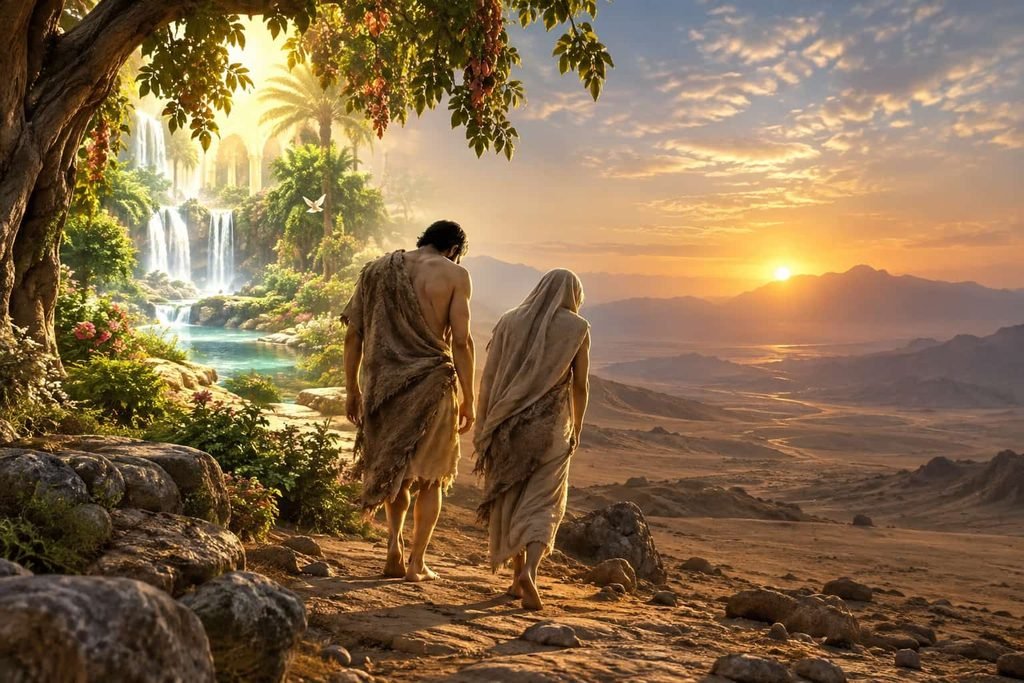
Chapter Three: Adam’s Repentance and His Descent from Paradise
Adam’s Mistake and the Acceptance of His Repentance
According to the narrations, Allah created Adam from clay and Eve from Adam. In Adam’s Repentance and His Descent from Paradise, Adam was honored by Allah. He and Eve were placed in Paradise to enjoy its blessings, except for one tree forbidden to eat.
When Adam approached the tree and ate from it, he remembered his Lord’s command. He became deeply sorrowful; Adam’s Repentance and His Descent from Paradise followed as he humbled himself before Allah.
The Quran relates the words of Adam and Eve:
“Our Lord, we have wronged ourselves. If You do not forgive us and have mercy upon us, we will surely be among the losers.”
Allah accepted Adam’s Repentance and His Descent from Paradise, showing that returning to Allah is always worthy of mercy.
The Five Daily Prayers and the Story of Adam
In one narration, the Prophet Muhammad (peace and blessings be upon him and his family) explained the significance of the five daily prayers in relation to the events of Adam’s life.
The time of Asr is associated with the moment when Adam ate from the tree and was subsequently sent out of Paradise. Maghrib is associated with the time when Allah accepted Adam’s repentance.
It is narrated that Adam prayed three units at that time: one for his own mistake, one for Eve’s mistake, and one as an expression of repentance. These three units later became part of the prescribed Maghrib prayer.
The Origin of Ablution
The narrations also connect the practice of ablution with Adam’s experience.
After Adam ate from the tree, he placed his hand upon his head and wept. When Allah accepted his repentance, Adam was commanded to wash and wipe specific parts of the body.
The face was washed because Adam had looked toward the tree. The arms were washed because he had reached toward it, and the feet were wiped because they had walked toward the forbidden tree.
Thus, the narration presents ablution as a reminder of Adam’s experience, repentance, and return to obedience.
The Thirty Days of Fasting
The narrations also mention a connection between Adam and the thirty days of fasting.
After Adam ate from the tree, the effects of the food remained in his body for thirty days. Therefore, fasting for thirty days was prescribed for his descendants.
The Prophet Muhammad (peace and blessings be upon him and his family) then recited the verse:
“Fasting is prescribed for you as it was prescribed for those before you, so that you may attain righteousness.”
Thus, fasting is presented as another practice connected in the narrations with the experience of Adam.
The Dialogue Between Moses and Adam
A narration from Imam al-Sadiq (peace be upon him) relates that Moses asked Allah to allow him to meet Adam. When they met, Moses asked Adam why he had disobeyed Allah after Allah had created him, breathed into him of His spirit, commanded the angels to prostrate before him, placed him in Paradise, and warned him not to eat from the tree.
Adam asked Moses how long before his creation he had found the event of his mistake recorded in the Torah.
Moses replied that he had found it recorded thirty years before Adam’s creation.
Adam then said that this was part of what had been decreed for him.
The narration concludes that Adam prevailed over Moses in the argument. The discussion is connected to the profound subject of divine knowledge, decree, and destiny.
What Was the Tree?
There are different narrations concerning the identity of the tree from which Adam and Eve ate.
Some narrations identify it with wheat, while others mention grapes, the lote tree, the fig tree, the tree of knowledge, or the tree of immortality.
Another narration explains that the trees of Paradise were unlike the trees of this world. A single tree could bear different kinds of fruits, which explains why different narrations describe its fruit differently.
The important point in the story is not merely the identity of the tree, but the divine command associated with it and the trial that Adam and Eve experienced.
Satan’s Deception
According to the narrations, Satan attempted to deceive Adam and Eve after he had been expelled from Paradise.
He approached Adam and attempted to convince him that eating from the tree would bring him a higher status or immortality. When Adam did not accept his deception, Satan approached Eve and tried to convince her that the prohibition had been lifted.
Eve approached the tree, and the angels did not prevent her because Allah had granted Adam and Eve reason, understanding, and free choice. They were therefore left to choose whether to obey or disobey the command.
Eve then ate from the tree and told Adam that she had done so without suffering any immediate harm. Adam was consequently deceived and also ate from it.
The two then experienced the consequences of their action and were removed from the blessings in which they had been living.
Adam’s Descent from Paradise
After Adam and Eve ate from the tree, Allah commanded them to descend from Paradise to the earth.
Their descent marked the beginning of humanity’s life on earth, where Adam and his descendants would live, work, experience trials, and eventually face death.
The narrations emphasize that Satan became an enemy of Adam, Eve, and their descendants, while humanity would remain in opposition to Satan and his descendants.
The earth would become their place of settlement and livelihood for a limited period.
Was Adam’s Action a Sin?
The story of Adam has been discussed extensively regarding the meaning of his “disobedience.”
The narration explains that the word used for disobedience does not necessarily mean that Adam committed a major or deliberate sin in the way ordinary people might understand sin. Rather, the discussion is connected to the concept expressed by the statement:
“The good deeds of the righteous are the shortcomings of those brought near.”
According to this understanding, Adam’s action was a departure from what was more appropriate for his exalted station, followed by sincere repentance and the acceptance of that repentance by Allah.
Adam’s Grief for Paradise
After his descent, Adam experienced profound sorrow for Paradise.
Imam al-Sadiq (peace be upon him) is reported to have said that among those known for their abundant weeping were Adam, Jacob, Joseph, Fatima the daughter of Muhammad, and Ali ibn al-Husayn.
Adam wept so much over Paradise that tears formed deep channels on his cheeks.
Another narration describes his tears as being so abundant that they were compared to the waters of the Tigris.
Adam’s tears therefore became a symbol of his profound regret, longing for Paradise, and sorrow after his descent to the earth.
The Lesson of Adam’s Repentance
The story of Adam is not only a story of a mistake. It is also a story of repentance, humility, divine mercy, and the consequences of human choice.
Adam remembered his Lord, acknowledged what had happened, regretted his action, and turned back to Allah. His story teaches that even after a serious trial, the door of repentance remains open to those who sincerely return to their Lord.