
The Story of Prophet Adam (AS) — Chapter 2
The creation of Adam was followed by one of the most significant events in the early history of humanity: Allah commanded the angels to prostrate before Adam.
This command was not a command to worship Adam. Rather, it was a divine command through which Adam was honored and the obedience of the angels was demonstrated. It was also the moment when the pride and rebellion of Iblis became manifest.
The Quran recounts this event in several passages and reveals the beginning of the great enmity between Iblis and the children of Adam.
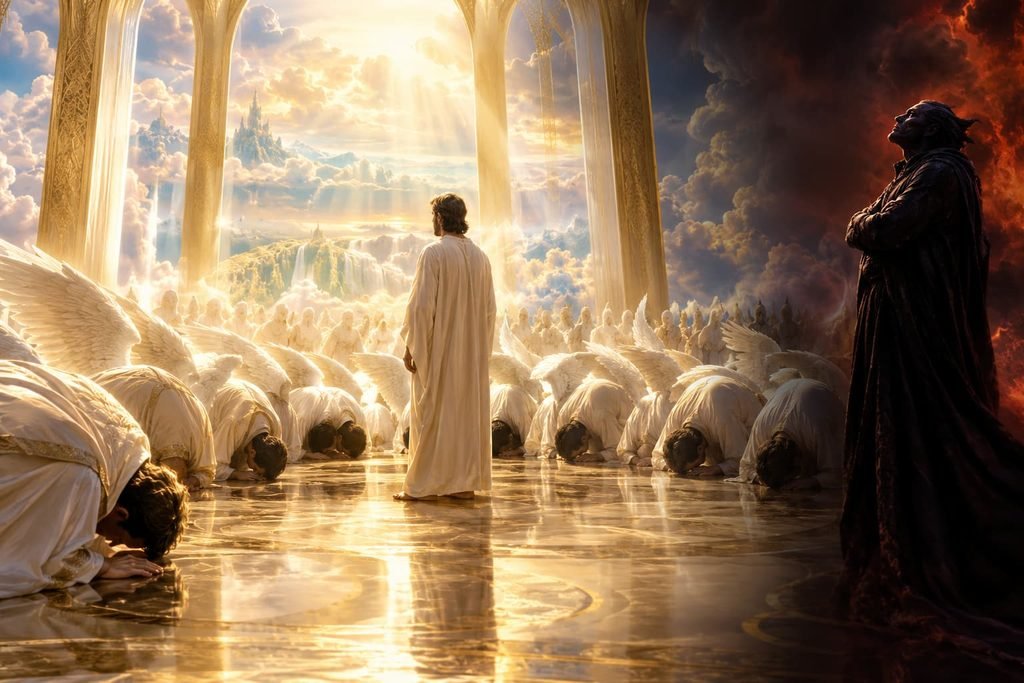
Allah Commands the Angels to Prostrate Before Adam
Allah Almighty says:
«“And when We said to the angels, prostrate before Adam,’ they prostrated, except Iblis. He refused, was arrogant, and became one of the disbelievers.”
— Quran 2:34»
Allah also says:
«“What prevented you from prostrating when I commanded you?” He said, “I am better than him. You created me from fire and created him from clay.”
— Quran 7:12»
Iblis believed that his origin made him superior to Adam. He compared fire with clay and concluded, according to his own reasoning, that he was better than Adam.
This was the beginning of his rebellion.
Who Was Iblis?
The Quran makes an important distinction regarding Iblis:
«“Except Iblis. He was of the jinn, and he departed from the command of his Lord.”
— Quran 18:50»
Islamic scholars have differed concerning the precise nature of Iblis before his rebellion.
A number of scholars, including many of the theologians among the followers of Ahl a-bayt, held that Iblis was from the jinn and was never one of the angels.
Other scholars held that he had been among the angels or had been regarded by them as one of their own because of his prolonged worship and presence among them.
One narration attributed to Imam Jafar a-Sadie (peace be upon him) states that the angels considered Iblis to be one of them, while Allah knew that he was not. When the command to prostrate came, what was hidden within him became apparent.
Thus, regardless of the different interpretations concerning his earlier status, the Quran explicitly describes Iblis as being from the jinn.
Why Did Iblis Refuse to Prostrate?
Iblis himself explained his refusal:
«“I am better than him. You created me from fire and created him from clay.”
— Quran 7:12»
His argument was based on a false comparison.
He considered fire superior to clay and therefore believed himself superior to Adam.
But the true measure of honor is not the material from which a creature was created. It is obedience to Allah.
The angels obeyed the command even though they were not asked to understand every aspect of its wisdom. Iblis, however, placed his own judgment above the command of his Lord.
This is why arrogance became the defining characteristic of his rebellion.
Iblis and the First Act of Arrogance
Ali son Ibrahim is reported to have described arrogance as the first sin committed against Allah.
According to this narration, Iblis asked Allah to excuse him from prostrating before Adam, claiming that he would worship Allah with a form of worship unlike that of any other creature.
But Allah made clear that worship is not based on what the servant chooses for himself. True worship requires obedience to Allah’s command.
Iblis refused.
Allah therefore commanded him:
«“Then get out of it, for you are accursed.”
— Quran 38:77»
The lesson is profound: a person cannot claim obedience to Allah while deliberately rejecting a command simply because it conflicts with his own opinion.
The Prostration Was Not an Act of Worshiping Adam
A natural question arises:
How could Allah command the angels to prostrate before Adam when prostration is an act of worship?
Islamic scholars have agreed that the angels did not worship Adam.
Several explanations have been offered.
One interpretation is that the prostration was ultimately directed toward Allah, while Adam served as the object or direction through which the command was fulfilled.
Another interpretation understands the prostration as an act of honor and recognition of Adam’s special status.
According to several narrations attributed to the Imams of Ahl a-bayt, the angels prostrated before Adam as an act of honoring him, while their obedience was ultimately obedience to Allah.
Imam Ja’far a-Sadie (peace be upon him) is reported to have explained that whoever prostrates by Allah’s command has, in reality, prostrated to Allah.
Thus, the command was a test of obedience and an honor bestowed upon Adam—not permission to worship Adam.
The Honor Given to Adam
Another narration attributed to Imam Ali al-Rida (peace be upon him) explains that the prostration of the angels was not because Adam was worthy of worship, but because Allah had honored him.
Adam had been given knowledge that the angels had not been given in the same manner.
Allah says:
«“And He taught Adam the names—all of them.”
— Quran 2:31»
The prostration therefore demonstrated Adam’s honored position while simultaneously demonstrating the angels’ complete submission to Allah.
Iblis Asks for Respite
After his rebellion, Iblis asked Allah to grant him respite:
«“He said, ‘My Lord, then reprieve me until the Day they are resurrected.’ He said, ‘Indeed, you are of those reprieved, until the Day of the known time.’”
— Quran 15:36–38»
Iblis did not ask for forgiveness.
Instead, he asked for time.
His purpose was to use that time to mislead the descendants of Adam.
Allah granted him respite for a period known only according to His divine wisdom.
Iblis Declares War on the Children of Adam
Iblis then declared:
«“Because You have put me in error, I will surely sit in wait for them on Your straight path. Then I will come to them from before them and from behind them and from their right and from their left, and You will not find most of them grateful.”
— Quran 7:16–17»
This declaration reveals the nature of Satan’s mission.
He does not merely invite human beings to commit one particular sin. Rather, he attempts to approach them from every direction, exploiting their weaknesses and turning them away from gratitude and obedience.
The Four Directions of Satan’s Temptation
A narration attributed to Imam Muhammad al-baqir (peace be upon him) provides an interpretation of the four directions mentioned by Iblis.
“From before them” refers to making the Hereafter seem distant or insignificant.
“From behind them” refers to encouraging people to accumulate wealth and withhold it from its rightful obligations.
“From their right” refers to corrupting religious matters through false ideas and attractive misconceptions.
“From their left” refers to beautifying worldly pleasures and allowing desires to dominate the heart.
These explanations illustrate an important principle: temptation can appear in many forms.
Sometimes it comes through desires. At other times it comes through wealth, doubts, false religious arguments, or neglect of the Hereafter.
Iblis’s False Analogy
One of the most important lessons in this story concerns the danger of reasoning incorrectly.
Iblis used analogy when he said:
«“You created me from fire and created him from clay.”
— Quran 7:12»
His reasoning was flawed because he judged the worth of Adam by his material origin rather than by Allah’s command and the honor Allah had granted him.
His error was not merely intellectual. It was moral.
He knew that Allah had commanded him, yet he allowed pride to override obedience.
For this reason, Islamic teachings repeatedly warn against arrogance and against placing personal judgment above divine guidance.
Iblis’s Vow to Mislead Humanity
Allah recounts another statement of Iblis:
«“By Your might, I will surely mislead them all, except Your chosen servants among them.”
— Quran 38:82–83»
Iblis therefore recognized that there would be people whom he could not ultimately overcome: Allah’s sincere and devoted servants.
His power is therefore not absolute.
Human beings may be tempted, but they are not forced to obey Satan.
Faith, remembrance of Allah, sincere repentance, and obedience provide protection against his deception.
Allah’s Mercy Toward Adam and His Descendants
According to a narration attributed to Imam Ja’far a-Sadie (peace be upon him), Adam asked Allah about the power that had been granted to Iblis over his descendants.
Allah explained that a bad deed would be counted as one deed, while a good deed would be multiplied many times over.
The door of repentance would also remain open.
This meaning is consistent with the broader Quranic teaching that Allah’s mercy remains available to those who sincerely return to Him.
Allah says:
«“Say, O My servants who have transgressed against themselves, do not despair of the mercy of Allah. Indeed, Allah forgives all sins. Indeed, it is He who is the Forgiving, the Merciful.’”
— Quran 39:53»
The story of Adam is therefore not only a story about temptation. It is also a story about divine mercy.
Which Paradise Did Adam Enter?
Muslim scholars have differed concerning the nature and location of the garden in which Adam and Eve lived.
Some scholars held that it was the eternal Paradise prepared for the righteous.
Others argued that it was a garden on Earth or a garden other than the eternal Paradise.
Several narrations attributed to the Imams of Ahl a-bayt describe Adam’s garden as one of the gardens of this world.
One narration attributed to Imam Ja’far a-Sadie (peace be upon him) states that the garden of Adam was a garden in which the sun and moon could be seen.
Another report states that Adam and Eve remained there for only a short period before being sent down to Earth.
Because Islamic scholars have differed on this issue, it is better to present the different interpretations rather than claim that one view is unanimously established.
Was Iblis an Angel or a Jinn?
This question has been discussed extensively by Muslim scholars.
The Quran gives the clearest description:
«“He was of the jinn, and he departed from the command of his Lord.”
— Quran 18:50»
Many scholars therefore conclude that Iblis was a jinn.
Some earlier interpretations, however, considered him to have been among the angels or to have occupied a position among them because of his worship.
According to narrations attributed to the Imams of Ahl a-bayt, the angels regarded Iblis as one of them, while Allah knew his true nature.
The Quranic statement that he was from the jinn remains central to the discussion.
The Meaning of “The Known Time”
When Iblis asked to be granted respite until the Day of Resurrection, Allah said:
«“Until the Day of the known time.”
— Quran 15:38»
Some narrations attributed to the Imams interpret this expression in connection with the events surrounding the end of worldly history and the coming of the promised divine events.
A narration attributed to Imam Ja’far a-Sadie (peace be upon him) identifies the “known time” with an event in which Iblis is finally defeated.
These reports should be understood as transmitted interpretations rather than as an explicit Quranic explanation.
The Virtue of Adam and the Role of the Ahl a-bayt
Some Shi’a narrations describe Adam’s story in connection with Muhammad, Ali, Fatima, Hasan, and Husayn (peace and blessings be upon them).
One narration attributed to the Prophet Muhammad (peace and blessings be upon him and his family) describes five exalted lights associated with the Divine Throne before the creation of Adam.
According to this narration, Adam’s creation and the prostration of the angels were connected to the special honor Allah had granted to him and to these exalted figures.
Other narrations describe Adam seeking nearness to Allah through them after his descent.
These reports belong to the Shi’a tradition and should therefore be understood within that theological context.
What the Story of Iblis Teaches Us
The story of Iblis contains lessons that remain relevant to every generation.
1. Arrogance Can Destroy a Person
Iblis was not ignorant of Allah. His downfall came through pride and refusal to obey.
2. Knowledge Without Obedience Is Not Enough
A person may possess knowledge and still fall into error if knowledge does not lead to humility and obedience.
3. False Reasoning Can Lead to Rebellion
Iblis constructed an argument based on the materials from which Adam and Iblis were created. But his reasoning ignored Allah’s command.
4. Satan’s Influence Is Not Absolute
Iblis can tempt, whisper, and deceive, but he cannot force a sincere servant of Allah to sin.
5. Repentance Remains Open
The story of Adam and his descendants is also a story of divine mercy. Human beings may fall, but they can return to Allah.
6. True Honor Comes From Allah
Adam’s honor did not come from the substance from which he was created. It came from the knowledge, responsibility, and honor Allah granted him.
Conclusion
The command to the angels to prostrate before Adam was one of the earliest great tests in the history of humanity.
The angels obeyed Allah, while Iblis allowed arrogance to overcome obedience. His refusal exposed what had been hidden within him and began his declared hostility toward Adam and his descendants.
The Quran presents Iblis as an enemy who seeks to lead humanity away from the straight path. Yet his influence has limits, and Allah’s mercy remains greater than his deception.
Adam’s story therefore contains two contrasting paths: the path of humility and obedience, and the path of arrogance and rebellion.
The next stage of the story brings Adam and Eve into the garden, where they will face another test—and where Iblis will attempt to fulfill the vow he made against the children of Adam
Continue the Story
Previous Chapter: The Creation of Adam and the Beginning of Humanity
Next Chapter: Adam and Eve in Paradise