

The Story of Prophet Adam (AS)
Chapter 1
The story of Prophet Adam (peace be upon him) is the beginning of the story of humanity. The Qur’an presents Adam as the first human being and the first prophet, and describes his creation, the knowledge Allah granted him, and the honor with which he was distinguished among His creation.
His story also introduces several fundamental themes: human responsibility, divine knowledge, free will, obedience, and the beginning of humanity’s journey on Earth.
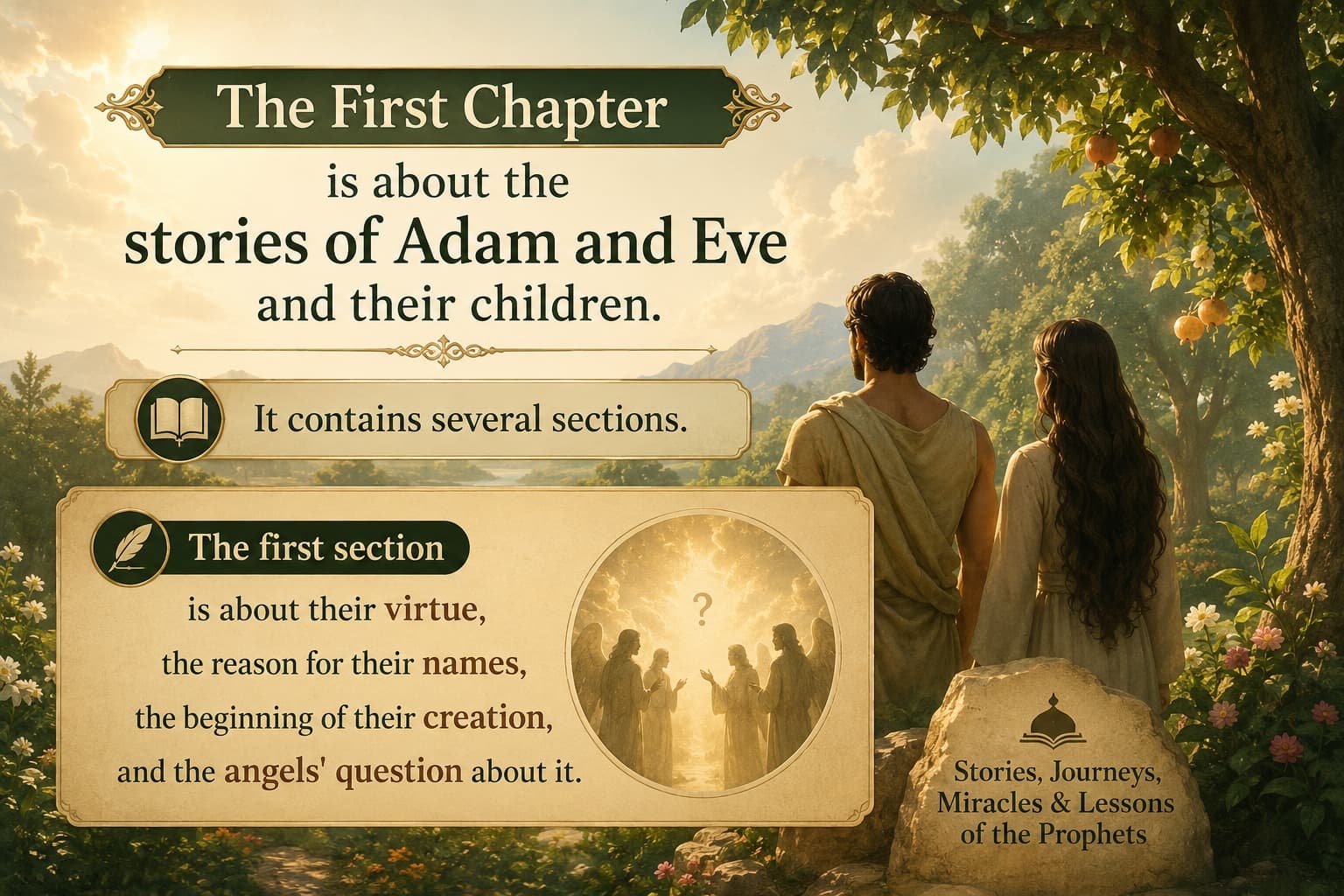
Allah Announces the Creation of Adam
Allah Almighty says:
“And when your Lord said to the angels, ‘Indeed, I will make upon the earth a successive authority.’ They said, ‘Will You place upon it one who causes corruption therein and sheds blood, while we glorify You with praise and declare Your holiness?’ He said, ‘Indeed, I know that which you do not know.’”
— Qur’an 2:30
This verse marks the beginning of a new chapter in the history of creation.
Allah informed the angels that He would place a khalifah on Earth. The term khalifah is commonly understood as a successor, representative, or one entrusted with responsibility.
The angels asked about the wisdom behind creating a being who might cause corruption and shed blood. Their question was not an act of disobedience or opposition to Allah. Rather, it reflected their desire to understand the wisdom behind the creation of humanity.
Allah answered:
“Indeed, I know that which you do not know.”
— Qur’an 2:30
Human beings would possess weaknesses and desires, but they would also possess knowledge, reason, moral responsibility, and the ability to worship Allah through conscious choice.
Allah Teaches Adam the Names
Allah then describes one of the greatest distinctions given to Adam:
“And He taught Adam the names—all of them. Then He presented them to the angels and said, ‘Inform Me of the names of these, if you are truthful.’ They said, ‘Glory be to You; we have no knowledge except what You have taught us. Indeed, it is You who is the All-Knowing, the All-Wise.’”
— Qur’an 2:31–32
Allah then said to Adam:
“O Adam, inform them of their names.”
And when Adam informed them of their names, Allah said:
“Did I not tell you that I know the unseen of the heavens and the earth, and I know what you reveal and what you conceal?”
— Qur’an 2:33
The teaching of the names demonstrates Adam’s capacity for knowledge and understanding.
The Qur’an does not provide a detailed explanation of exactly what all these names were. Muslim scholars and commentators have therefore offered different interpretations.
Some understood the names to refer to the names of created things, while others understood the verse more broadly as referring to the knowledge and intellectual abilities Allah granted Adam.
Whatever the precise meaning, the passage clearly establishes that Adam was given knowledge that distinguished him from the angels in this particular test.
The Creation of Adam from Clay
The Qur’an repeatedly describes Adam’s creation from earthly material.
Allah says:
“Indeed, the example of Jesus to Allah is like that of Adam. He created Him from dust; then He said to him, ‘Be,’ and he was.”
— Qur’an 3:59
Allah also says:
“He created man from clay like pottery.”
— Qur’an 55:14
And He says:
“And when your Lord said to the angels, ‘Indeed, I am going to create a human being from clay.’”
— Qur’an 38:71
These verses emphasize the humble physical origin of humanity.
Human beings may possess intelligence, knowledge, and extraordinary abilities, yet their physical origin is from the earth. This serves as a reminder that human honor comes not from arrogance about one’s material origin, but from obedience, knowledge, faith, and righteousness.
The Name Adam
Several narrations discuss the origin and meaning of the name Adam.
According to a narration attributed to Imam Ja’far al-Sadiq (peace be upon him), Adam was given this name because he was created from the surface of the Earth, known as adim.
Other linguistic interpretations have also been mentioned by scholars. Some have connected the name with meanings related to the earth or to human complexion.
These interpretations should be understood as explanations found in Islamic sources rather than as matters explicitly defined by the Qur’an.
The Creation of Eve (Hawwa)
After the creation of Adam, Allah created his wife, Eve (Hawwa), so that humanity would begin with a man and a woman.
The Qur’an says:
“O mankind, fear your Lord, who created you from one soul and created from it its mate and dispersed from both of them many men and women.”
— Qur’an 4:1
The Qur’an therefore presents Adam and his wife as the beginning of human family life.
Some Islamic narrations discuss the manner in which Eve was created. Among the narrations attributed to the Imams of Ahl al-Bayt is a report rejecting the idea that Eve was created from Adam’s left rib and instead describing her creation as being from the same earthly substance from which Adam was created.
Because different traditions have transmitted different explanations, it is important to distinguish between what the Qur’an explicitly states and what later narrations and interpretations explain.
The Diversity of Humanity
Islamic narrations also discuss the connection between the earthly origin of Adam and the diversity found among his descendants.
A narration attributed to the Prophet Muhammad (peace and blessings be upon him and his family) states that Adam was created from different types of clay.
This narration has been understood as an explanation for the diversity among human beings in appearance, complexion, temperament, and characteristics.
Humanity therefore shares a common origin, despite the enormous diversity found among peoples and individuals.
The Qur’an emphasizes this common origin:
“O mankind, indeed We have created you from male and female and made you peoples and tribes that you may know one another. Indeed, the most noble of you in the sight of Allah is the most righteous of you.”
— Qur’an 49:13
Human diversity is therefore not a basis for arrogance or superiority. According to the Qur’an, true honor is connected to righteousness.
Adam’s Unique Place Among Creation
The creation of Adam was accompanied by several distinctions.
Allah taught him knowledge, honored him with responsibility on Earth, and prepared him for a role unlike that of the creatures who had preceded humanity.
Adam was not created merely to live for worldly existence. His story represents the beginning of humanity’s moral journey: a journey in which human beings would be tested, guided by revelation, and held responsible for their choices.
The creation of Adam therefore carries both honor and responsibility.
Human beings were given intellect and knowledge, but they were also given desires and weaknesses. Their success lies in learning to discipline those desires and use their abilities in obedience to Allah.
Lessons from the Creation of Adam
The beginning of Adam’s story contains several important lessons.
1. Human beings share a common origin.
All humanity ultimately traces its earthly origin back to Adam and Eve.
2. Knowledge is a great divine blessing.
Allah distinguished Adam by teaching him knowledge, reminding humanity of the importance of learning and understanding.
3. Honor does not come from physical origin.
Although Adam was created from clay, Allah honored him through knowledge, responsibility, and obedience.
4. Human beings have a responsibility toward the Earth.
The description of Adam as a khalifah establishes the idea of responsibility and stewardship.
5. Human weakness does not mean that humanity was created without purpose.
Human beings possess desires and emotions, but they also possess intellect and the ability to choose obedience.
6. Arrogance contradicts the purpose of human creation.
The story of Adam will soon reveal how arrogance can lead a creature away from obedience to Allah.
Conclusion
The creation of Adam marks the beginning of humanity’s journey.
Allah created Adam from the earth, granted him knowledge, and entrusted humanity with responsibility on Earth. He then created Eve and began the human family.
Yet the story was only beginning.
Soon after Adam’s creation, Allah commanded the angels to prostrate before him. This command would reveal one of the greatest tests in the early history of creation: the rebellion of Iblis.
The next chapter explores the meaning of that prostration, the identity of Iblis, his refusal to obey Allah’s command, and his declaration of enmity toward Adam and his descendants.
Continue the Story
Chapter 2 — The Prostration of the Angels and the Trial of Iblis